
A screenshot appears to show American Airlines charging very different first class fares for the same flight at the same time depending upon whether the user was logged into an AAdvantage account. If true, that would be deeply troubling. But I am not convinced the screenshot proves what some think it proves.
Is American Airlines Charging Different Fares Based On Your Status? A Viral Screenshot Raises Questions
A screenshot circulating online has raised fresh concerns about so-called “surveillance pricing” in airline tickets.
The image appears to show the same American Airlines flight from Dallas/Fort Worth (DFW) to Anchorage (ANC) on September 4, 2026, departing at 3:15 PM and arriving at 7:10 PM.
On one device, an iPhone with no AAdvantage status, the first class fare appears as $1,735 one-way. On another device, an iPad logged into an AAdvantage Platinum Pro account, the same first class fare appears as $4,038 one-way.
The economy fares appear to be the same, with Basic Economy at $262 and Main Cabin at $317. But the first class difference is huge.
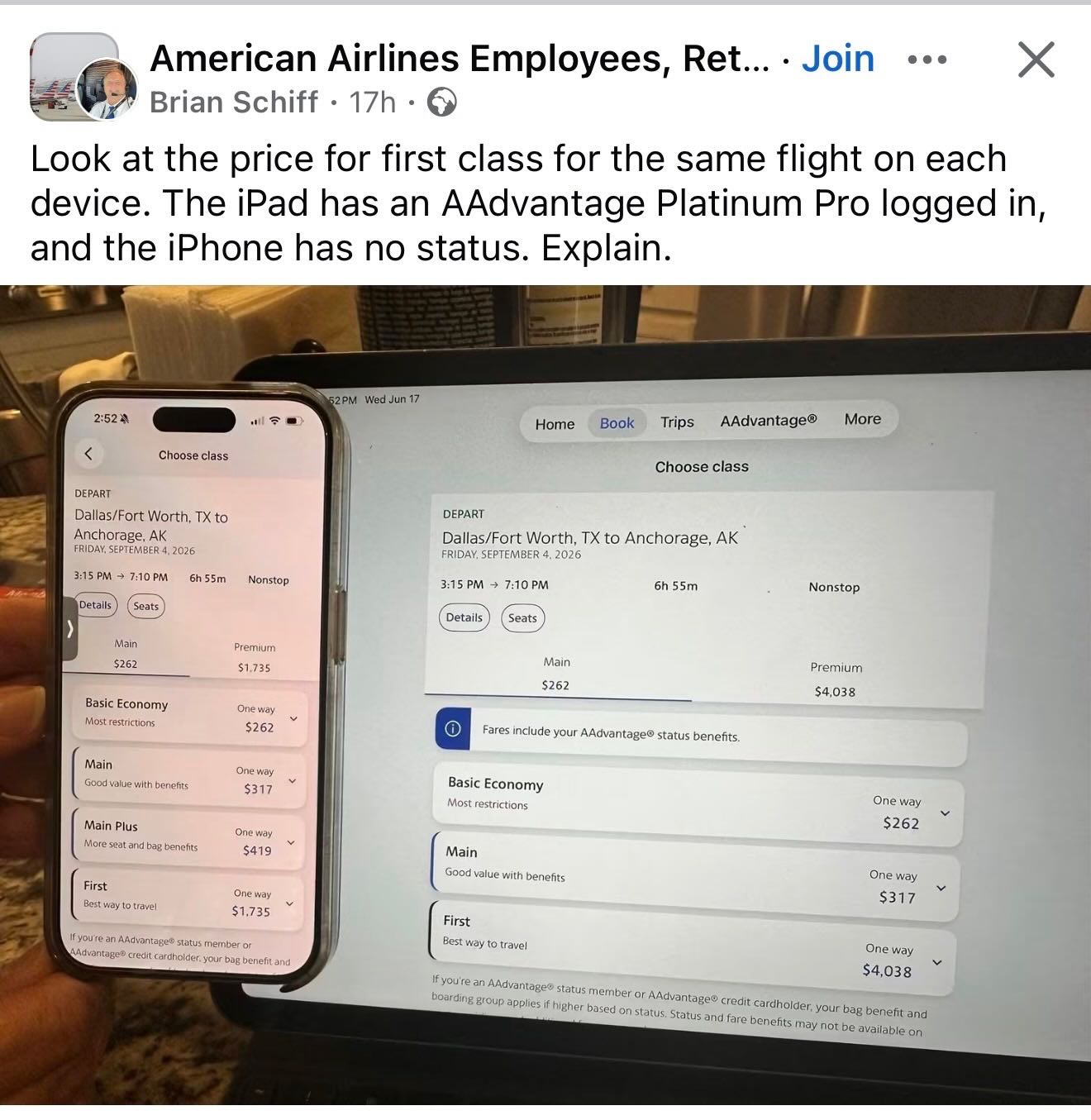
The caption asks: “Look at the price for first class for the same flight on each device. The iPad has an AAdvantage Platinum Pro logged in, and the iPhone has no status. Explain.”
It is a fair question.
If American Airlines, or any airline, is charging different fares in real time based on who you are, what device you are using, whether you are logged into a loyalty account, how often you search a route, or how much the algorithm thinks you are willing to pay, that should be one of the most talked-about consumer issues in Washington.
And if lawmakers are not all over that, they should be.
Surveillance Pricing Would Be A Predatory Step Too Far
Airline pricing has always been complicated. Two people sitting next to each other in the same cabin can pay wildly different prices for the same flight. That is nothing new.
Think about a typical flight. Some booked early, some late. Some bought a refundable fare, some used miles. Some bought during a sale, some used a corporate contract. One booked the last seat…that is simply part of how airline revenue management has worked for decades. But surveillance pricing is different.
The concern is that an airline might use personal data to decide what you, specifically, are willing to pay and then quote you a higher price than another traveler for the same seat at the same moment.
That crosses a line for me.
If an airline cabin is full of people who paid different prices because they purchased at different times or under different fare rules, fine. But two people searching the same flight at the same time and seeing different prices because one is logged into an elite account? That feels predatory.
It would also be an astonishing betrayal of loyalty.
Imagine earning Platinum Pro or Executive Platinum status, giving American Airlines years of business, and then being rewarded with higher prices because the system assumes you are captive, less price-sensitive, or more likely to pay up.
That would be exploitation, not loyalty.
But I Am Not Convinced This Screenshot Proves It
As troubling as the screenshot looks, I am not ready to declare American guilty here.
There are too many variables and since this was not a video of a real-time search ,we don’t know if one deice may have been refreshed earlier or showing a cached fare.
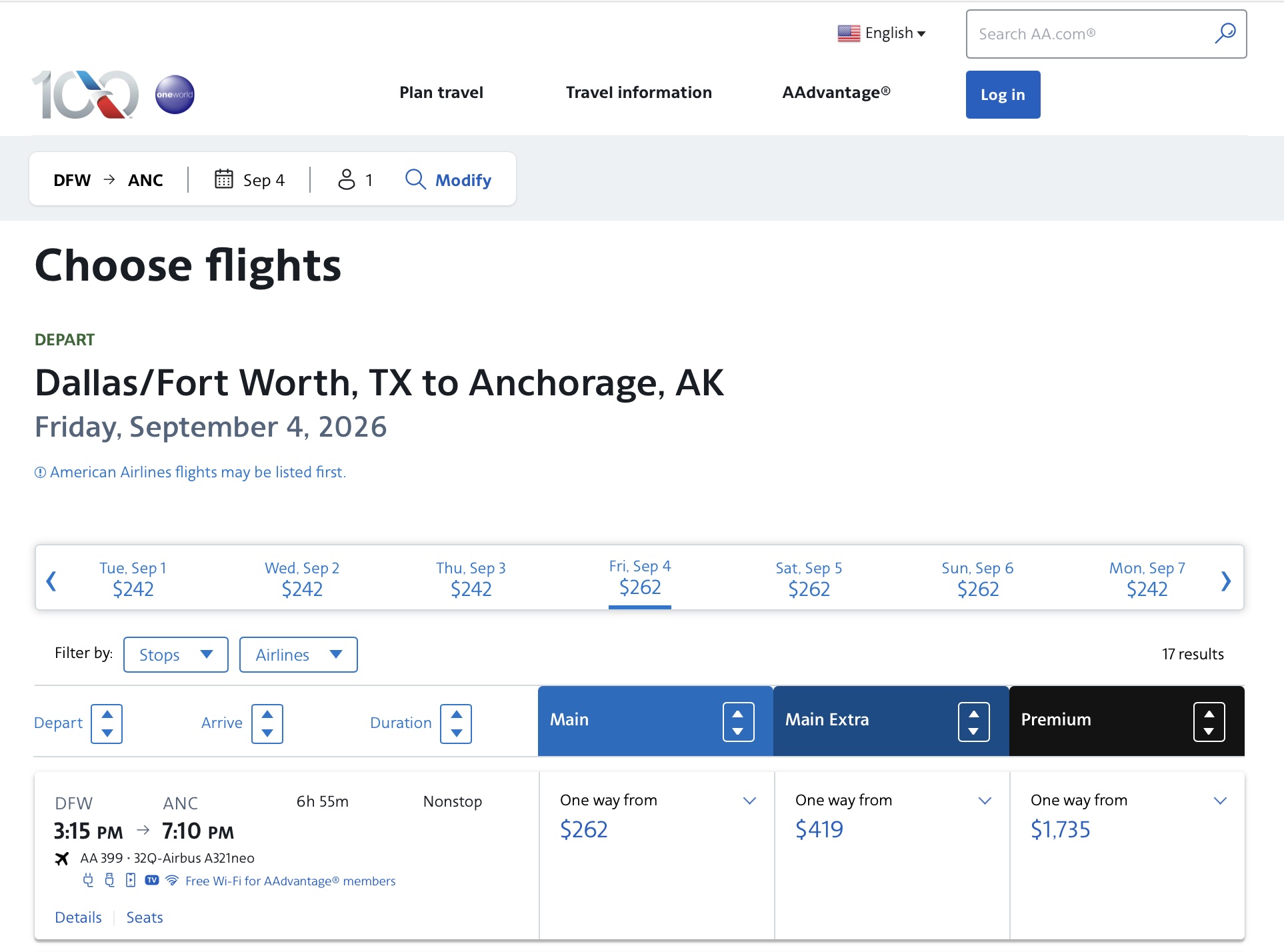
I also tried to reproduce this myself by searching routes in incognito mode and then while logged into an Executive Platinum account. I checked this route and several others and was not able to find real-time pricing differences based on status.
On aa.com in incognito mode:
On the AA app logged into an Advantage Executive Platinum account:
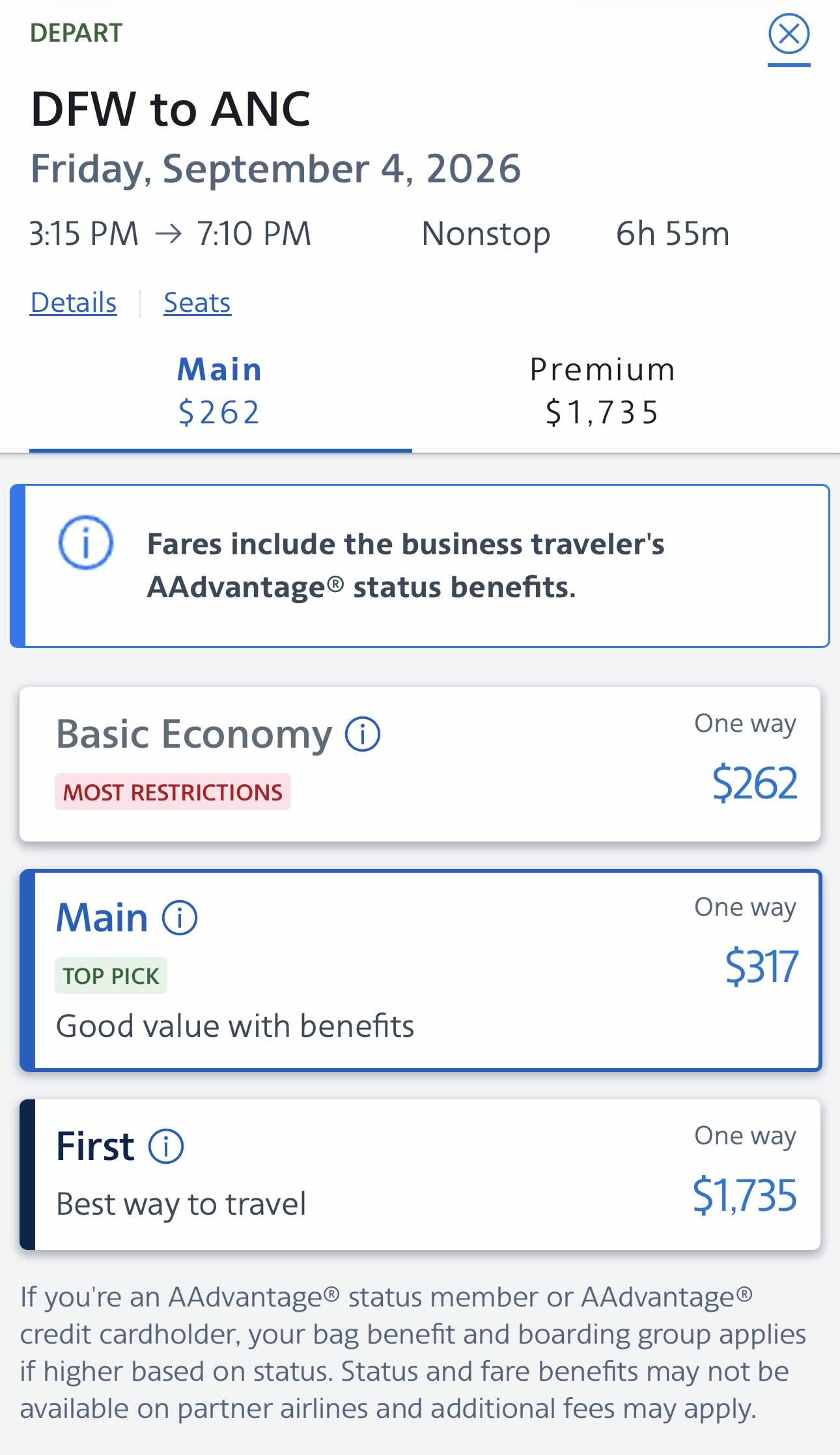
That does not mean surveillance pricing is not possible, but I could not replicate what has been claimed.
The technology clearly exists. Airlines already use sophisticated revenue management systems, dynamic pricing, personalized offers, and increasingly AI-driven tools. The question is whether they are actually using personal data to show different base fares to different people in real time.
I hope not.
The Incognito Workaround Is Not Good Enough
Some travelers will say the solution is simple: search in incognito mode, compare prices while logged out, then add your frequent flyer number later.
And yes, if surveillance pricing were being used, those “in the know” could potentially work around it that way.
But that is not good enough.
Consumers should not need to hide from an airline in order to get a fair quote. You should not have to clear cookies, use a different browser, open a private window, or avoid logging into your loyalty account because you fear your own profile may be used against you.
That is exactly why this issue deserves scrutiny.
If airlines want to dynamically price based on real-time inventory and demand, then fine. But if they are pricing based on personal data, loyalty status, perceived wealth, urgency, browsing history, or willingness to pay, that should be disclosed and regulated.
CONCLUSION
A viral screenshot appears to show a far higher American Airlines first class fare for the same DFW–Anchorage flight when the user was logged into a Platinum Pro AAdvantage account compared to a device with no status.
If that reflects actual surveillance pricing, it is outrageous. Charging different people different prices for the same seat at the same moment based on personal data would be a predatory practice and lawmakers should stop it.
But I am not convinced this screenshot proves that is what happened. I tried to reproduce similar pricing differences and could not. There may be a more innocent explanation, including caching, fare bucket changes, or plain old American Airlines IT weirdness.
Still, the concern is real. The technology exists and for airlines, there are many incentives to engage in this practice. Consumers deserve assurance that logging into a frequent flyer account is not a signal to charge them more.
For now, I will continue comparing prices while logged out and logged in…that should not be necessary?
Have you personally noticed any surveillance pricing from AA?





Enough is enough. We need to regulate Big Tech and these anti-consumer abuses of corporate power.
+1
1990… imagine seeing you here. Well, this is awkward.
This is EXACTLY what my concern was with Delta’s AI driven pricing model, which they got caught and claimed to have stopped. What the customer’s ABILITY to pay using AI engines is our likely future. AI can help any company know a lot about a customer way beyond what is available on an airlines membership information. This will likely spread across many other industries once it catches on, unless as you say, it somehow gets legislatively banned.
Surveillance pricing is absolutely happening. SFGATE reported back in 2025 that SF Bay Area residents were paying significantly higher prices for the exact same hotel rooms (in other parts of the country) than others booking on devices located elsewhere: https://www.sfgate.com/travel/article/hotel-booking-sites-overcharge-bay-area-travelers-20025145.php
I am grateful to you for reporting on this. Travel blogs and news sites seem reluctant to acknowledge that surveillance pricing is in full effect when everyday users see evidence of it all the time.
I don’t know why, but I feel like of all the status levels, a Platinum Pro would be the least likely to pay more for first than anyone else. If anything, AA knows they work in oil & gas and is targeting that.
I’m not saying it didn’t happen but your inability to prove it is telling. In today’s clicks for cash world I trust nothing controversial on social media. Too much financial incentive to make up garbage for attention.
I do agree it’s certainly possible though, I just not sure any airline is willing to risk the backlash from the government and the public if proven.
Both prices are absurd
Kyle, you’re lame!
Better than being called limp in my old industry.
Bring out the fluffer!
Almost certainly not what’s happening here. The flight is C1 (revenue C, not upgrade C) J4 with all other business classes zeroed out.
The lowest fare that can price J is JA2AA, while C can price under H0AWWNC1. (Lower sell-up fares require R, D, or I inventory which doesn’t exist.)
I’d bet very good money whoever ran this test input 1 passenger on the phone and 2 or more on the iPad. I can replicate the results exactly when doing that, regardless of logged in/out or elite status.
Occam’s Razor / PEBKAC error
This was my thinking too – the first search took the last of the lower fare inventory out (even though not purchased).
Matt, can you write a post on why you think this practice would be bad/predatory while the existing method of pricing is not? I’m having a hard time justifying a last minute ticket (which often demonstrates distress, whether for a funeral, business meeting, etc), but that is understood/accepted as being financially prudent for the airline.
Even leaving seats open when they could be sold for less (or points) is not decried when that is also a form of predatory pricing.
There’s already a level of stratification going on based on the person’s booking/purchase patterns, so why would increased personalization be an issue? Would it be a problem if used in reverse– where a loyal customer gets a discount? Are bereavement fares an issue since they’re ultra-customized and not available to the regular pax?
Not being combative– I have the same reaction as you but am having a hard time explaining it rationally.
Have you bought a car? Of course the offer they make you is tailored to their perception of your ability and willingness to pay. Heck people give universities details of their financials so the school can tailor an aid proposal based on that. Happy hour priving. Early bird specials. Lunch meals being better bargains than dinner. Lunch specials that don’t include weekends/holiday. Price discrimination is rampant and not an airline-only thing.
Why do airlines have higher last minute fares that they won’t drop even if the seat flies empty? It makes great sense. A lot of last minute travel is (or at least was) business travel. If it became known that airlines would reduce prices near departure just to sell the seat, why would anyone with even just a little flexibility not wait on popular routes?
I use Google to get prices, then use the airline app (which has me auto logged in) and have never seen a price change. The beauty of free markets is that the negative reaction to finding an airline doing this should prevent them from doing it. Also, fear of legislation helps.
Most likely the iPhone one was done first, and since it was in the process of being bought, it was held on the servers. This was the last ticket of that fare bucket.
Then the second one done on the iPad, does not see the cheaper fare bucket ticket since it’s currently being held, so the next fare bucket is shown.
That doesn’t occur until farther into checkout, once passenger names have been entered.
“I never lose, I either win or learn.” – Nelson Mandela –
In any case, stay alert if you can!
What shocked me more was that people actually still fly American.