
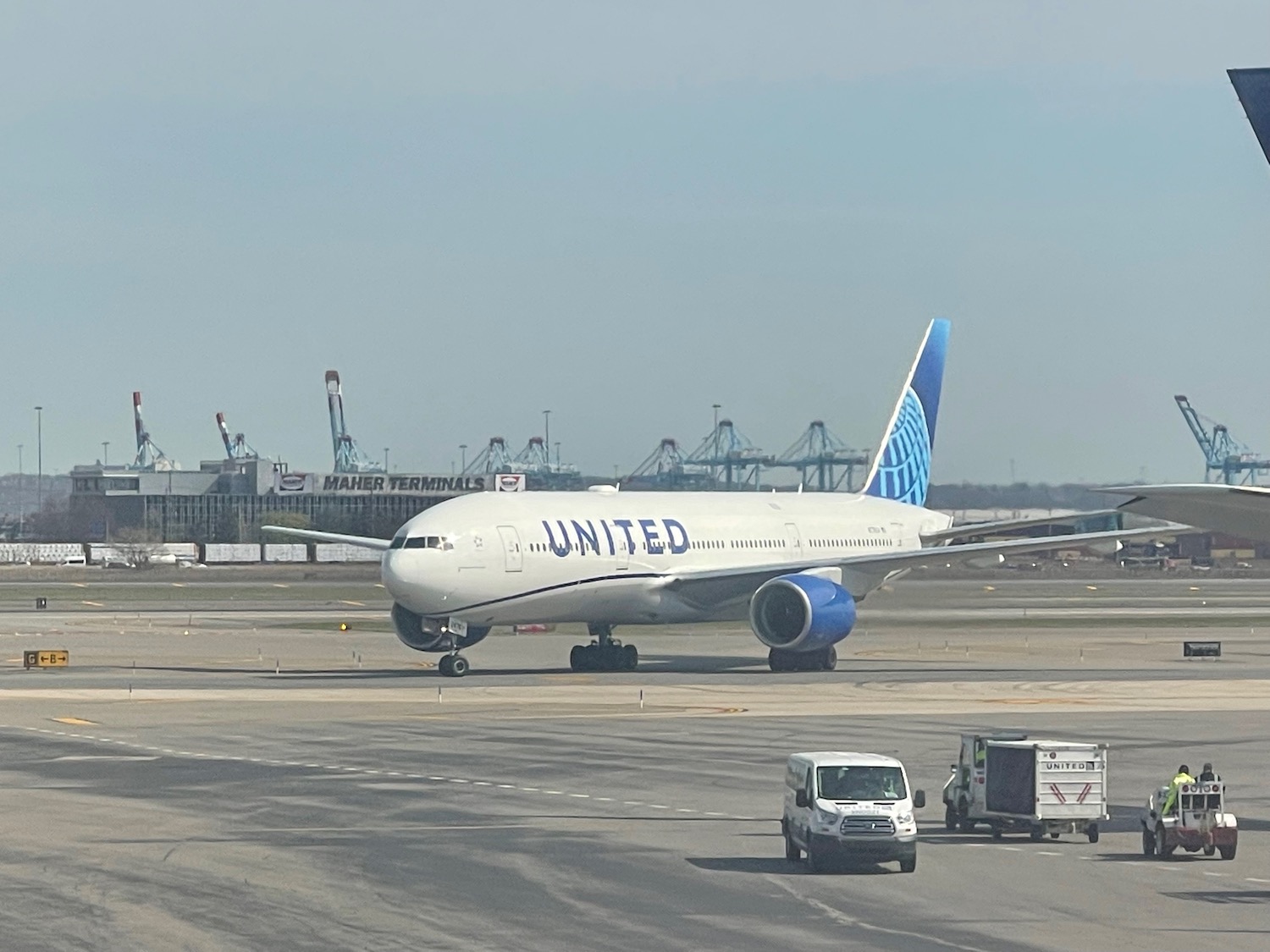
A United Airlines 777-200 incident at Dulles and a quiet schedule shift raise a bigger question about a widebody that increasingly looks like it has no long-term home in United’s fleet.
United’s Boeing 777-200 Is Quietly Being Phased Out, And Recent Events Show Why
A United Airlines Boeing 777 departing Washington Dulles (IAD) for Tokyo Haneda (HND) suffered an engine failure shortly after takeoff on December 13, 2025, shedding debris that ignited a brush fire near the airport. The aircraft returned safely, passengers were unharmed, and United emphasized that safety protocols worked exactly as intended:
“Shortly after takeoff, United flight 803 returned to Washington Dulles and landed safely to address the loss of power in one engine. There were no reported injuries. We’ve temporarily closed a United Club lounge at Dulles to help assist our customers and work to get them to their destinations. United is grateful to our crews and to the teams at Washington Dulles for their quick work to help ensure the safety of everyone involved.”
All of that may be true…and still miss the bigger story.
Because this incident comes as United is quietly pulling its remaining high-density domestic Boeing 777-200s from the schedule, it raises an obvious question. What exactly is the future of the 777-200 (-ER and non-ER) at United Airlines? Will the 787 Dreamliner fully replace it?
The Dulles Engine Failure Was Serious Even If It Ended Well
The aircraft involved was operating a routine departure from IAD when it experienced an engine malfunction that scattered debris beyond the airport perimeter. Fire crews responded to a brush fire, flights were disrupted, and the FAA opened an investigation.
United deserves credit for how the situation was handled operationally. The aircraft returned safely, and this was not a repeat of the United 328 Denver incident from 2021. Still, engine failures on aging widebodies attract scrutiny for a reason: they are rare, expensive, and underscore fleet-planning realities airlines cannot ignore.
United Is Quietly Removing Domestic High-Density 777s
Separately, FlyerTalk users have been tracking United’s quiet removal of domestic Boeing 777-200 flights from the schedule. These are the infamous high-density aircraft configured with large economy cabins, minimal premium seating, and no true long-term role beyond domestic trunk routes.
For years, United used these aircraft to maximize capacity on Hawaii and hub-to-hub flying, where gauge mattered more than passenger experience.
As these aircraft age, that logic no longer holds. These aircraft are expensive to operate, inefficient by modern standards, and mismatched with United’s current premium-heavy strategy. Pulling them from domestic service is not a temporary tweak, even if driven specifically by supply chain challenges with Pratt & Whitney engines. It looks structural.
The 777-200 Problem Is Not Safety. It Is Economics.
The Boeing 777-200 is not an unsafe airplane. As far as I can tell, that is not the issue even after the incident over Dulles over the weekend.
The issue is that United’s 777-200 fleet is old, maintenance-intensive, and increasingly difficult to justify economically. This is particularly true for the Pratt & Whitney PW4000-powered subfleet, where parts availability and long-term support have become growing challenges. But even the GE 777-200s are getting old.
United has not broadly retired all of its Pratt & Whitney-powered 777-200s. However, United has begun placing at least some of its oldest 777-200s into long-term storage in California’s Mojave Desert, including its very first Boeing 777, which recently marked 30 years of service. That move is widely viewed as symbolic of the aircraft’s shrinking role at the airline, even though United has not formally declared the entire subfleet permanently retired.
At the same time, United is investing heavily in:
- Boeing 787s for long-haul flying
- Airbus A321neos for domestic and transcontinental routes
- Premium-heavy cabins and more efficient narrowbodies
There is no obvious niche left for a 25-plus-year-old widebody that feels like flying on a budget carrier (hopefully the 757-200s are not far behind, but that’s another issue).
Why Incidents Like This Accelerate Fleet Decisions
Airlines rarely retire aircraft because of a single incident. But incidents like the IAD incident reinforce internal arguments that already exist.
Every disruption forces planners to ask whether the aircraft is still worth the complexity it brings to the network. Every unscheduled maintenance event tightens the math. Every FAA inquiry reminds management that aging fleets carry reputational risk, even when handled correctly.
The timing here is not coincidental.
What Comes Next For United’s 777-200 Fleet
The writing has been on the wall for years, but I think the UA803 incident crystallizes it.
Rather than an abrupt retirement, expect a slow drawdown:
- Continued removal from domestic schedules
- Reduced overall utilization
- More aircraft placed into storage as leases expire
- No meaningful interior refreshes or long-term investment
I still like that non-ER aircraft in the dorm-style 8-across business class, but it really is like stepping 20 years back in time. Even the longhaul-conifugred 772s just feel old onboard with their smaller overhead bins and horrible fluorescent lighting.
CONCLUSION
The Dulles engine failure was handled professionally, and it does not mean the Boeing 777-200 is unsafe, whether we are talking about GE or Pratt-Whitney engine variant. But it does highlight why this aircraft no longer fits United’s future.
Between rising maintenance costs, declining efficiency, and a network strategy focused on newer aircraft and premium revenue, the 777-200 is running out of runway at United.
The quiet schedule changes say more than this freak incident over Dulles does.






Ever since that Denver incident (UA328 in 2021), I’ve specifically avoided their 772s, especially the domestic variants with that awful 2-4-2 rear-facing business class ‘coffin seat’ that makes Delta’s 763s look good.
Maybe, after 30 years, these ancient aircraft are ‘done.’ Just as the MD-11 had to go at some point. So should these. 773, 787 are ‘good enough’ wide-body, long-haul for United and American. Airbus 339 and 350 are working well for Delta, so far. Sure, getting to 2030 seems like the plan, but the expected economic downturn may be what it takes for early retirement of these older ones (or a horrific accident, but it’d be nice to avoid that.) Besides, cargo operators are gonna be looking for a lot of 772 and 767 to replace their MD-11 fleets anyways.
The engines are not the only issue. There are an increasing number of flight diversions on the 777-200 with UA for varying mechanical aspects as well that are outside the engines. Just last week one headed to SFO from LHR diverted to EDI after two hours given issues with brakes. From what I understand the aircraft sat there for days. It seems of all the aircraft UA has it is the one type that I often see reported in diversions.
Seems it is time to send these old horses to the glue factory…but 1990 is correct that FedEx and UPS will scoop them up.
Finally, vindication! Bah…
Very unlikely these aircraft end up with UPS or FedEx. There is a reason there is currently no certified cargo conversion program for the 777-200 or 777-200ER. Even with significant structural enhancements they end up too heavy for their size to be competitive cargo haulers. 777 cargo conversions are focused on the 777-200LR and 777-300ER because of their similarity to the 777F with bigger engines and wings.
Sol, IAI is authorized, and you’re right that they’ve mostly done 773. I thought Mammoth took some of Delta’s 772s. Air India, the Arizona Cardinals, and others got some, too. There’s ample ability to convert these to other uses.
IAI’s conversion is for the 777-300ER. Mammoth’s conversions are for the 777-200LR and 777-300ER. First generation 777s are not going to be freighter conversions, the economics just don’t work. Sports and military charters, sure, they can do that for the rest of their years.
I think the bigger question is how do UA replace these planes in an era where order books are very full and the 777X is so incredibly behind schedule? Do they turn to second hand examples, like DL have done? Do they bring in a new type, like an A350? Or do they just accept lower capacity in the form of existing 787 orders?
I can’t imagine this hasn’t been on their radar for a while, so it’s probably the latter, as you speculated.
I think with yields to Europe weakening and South Pacific loads atrocious, United can smartly pull these 772s earlier than planned, reducing capacity even as it continues to take Dreamliner deliveries. If my numbers are correct, United took 25 787 deliveries this year…that’s really enough right now. And mothballing these old 772s in the desert doesn’t mean they cannot return to service if needed.
actually, Matthew, based on UA’s 3rd quarter guidance and their 2024 10K, UA only expects to receive 9 787s in 2025.
Their need to hold onto older aircraft is due in part to Boeing’s delivery delays.
And, not to turn this into a DL vs. UA battle, but DL has received more new Airbus widebodies for the past 2 years than any other US airline.
DL has been retiring 767-300ERs but DL’s A350-1000s are now delayed and they face a slim delivery schedule for 2026 with an expected order for 787s in 2026.
DL is clearly gunning for growing its presence in Asia so UA has reason to look over its shoulder…. but having older aircraft on your longest routes doesn’t help competitively or financially against a near all-A350 fleet at DL
“not to turn this into a DL vs. UA battle”… Tim, when have you not?!
He is bascially doing this all over the comments sections for just this post.
1990 and Aaron,
what I write here and elsewhere is either factually correct or it is not.
UA has a massive order book – as large as the rest of the entire US airline industry combined – but is not receiving aircraft at the rate that UA has in its contracts which are largely with Boeing.
UA came out of covid w/ a “we can kill the ULCCs and grow our share in every global region” mindset and has not retired widebodies unlike most other large airlines in the world.
UA’s revenue performance in the 3rd quarter was bottom of the US industry because of overcapacity that was not just present across the Atlantic but across the Pacific and Latin America – UA’s worst performing region – as well as domestic.
UA has no choice but to slow its growth if it wants to match or exceed DL’s financial performance which is what they say they want to do.
Matthew is absolutely right that fleet issues often lead to a re-evaluation of strategy. If this event was caused by a bird strike, engines are required to be able to withstand ingestion of certain size birds; this bird strike event could have involved larger or multiple birds.
UA has no choice but to start aggressively retiring widebodies, something it has not done for five years. whether this aircraft or GE powered 777s are on the near-term retirement list remains to be seen but I am betting alot of other aircraft will be much higher on the list of retirements.
Aaron, and he can and he should. I’m a fan of speech, even that which I disagree with. Why else even have comments sections here or elsewhere. I enjoy Tim’s passion, and hope he and other ‘keep it going’ as long as they enjoy it.
Tim, I see UA’s lack of receiving more aircraft as a Boeing-problem, even though ultimately United is paying the price. Delta scored by diversifying away from Boeing’s widebodies and by embracing 321neo, 339, and 359. I’m not affiliated, but I’ve become more-and-more a fan of Airbus, ever since the Max failures. Delta also dodged a bullet there, too.
Nah, it gets annoying and repetitive, and just makes you wonder why he shills for DL so hard and often. And why DL can never do anything wrong in his eyes.
I’d fully expect the expected parties to leave a sparky response to:
“DL has received more new Airbus widebodies for the past 2 years than any other US airline.”
since this has to be true with the word “Airbus” there. Typos happen.
As best I can decipher over the web, UA has received less than 7 787s this year.
let’s face it… DL turned to Airbus over the last 10 years and it has saved them a mountain of headaches that Boeing customers have faced.
DL is now supposed to be the launch US customer for the MAX 10 and a 787 order is expected so DL hasn’t bailed on Boeing.
They just took a pause when it mattered the most – and has managed to get airplanes delivered that other airlines wish they could have received.
Tim, I wish Delta would double-down on Airbus rather than court the Max-10 or 787, but, I don’t make those calls. I get it, though, in the current political climate, it makes sense to at least pretend to do business with an American company… gotta appease our Dear Leader, after all… at least Ed hasn’t had to give a golden idol like Tim ‘Apple’ did.
TD, “based on UA’s 3rd quarter guidance and their 2024 10K, UA only expects to receive 9 787s in 2025.”
2024 10k says 9 in 2025 and 20 in 2026 before Boeing’s 787 production outlook improved a bit.
Keep in mind United has two engine types. This was a GE powered aircraft which is much more reliable than the P&W powered 777s which had the previous incidents.
I understand there’s a Pratt engine shortage which is driving the schedule adjustments.
I make this very clear in my story.
@MatthewKlint “I make this very clear in my story.”
No, you never even identified that it was a GE powered 772er or that it was likely caused by a bird strike and would therefore have nothing to do with the age of the airplanes or their engines. You also make numerous claims and characterizations of the 777s without any supporting information or data. The article is misleading. Coincidence is not causation.
P&W have their hands full trying to rectify the disastrous GTF fiasco that’s not just arguably made a major contribution to Spirit’s failure, but has also pissed-off a LOT of customers around the world.
Matthew, please stop writing with ChatGPT. I like your voice.
This is my voice. What makes you think it is ChatGPT? If Chat can do this, sign me up!
Is their The 777-300 fleet facing similar issues?
No.
Let’s add that, as of today, UA has 22 Boeing 777-300ER jetliners (with an average age of 8 years) in its colossal fleet.
UA was a late comer to the 777-300. They, rumors suggest, got a good deal and now have a young fleet of that 777 subset.
This aircraft was not a particularly old aircraft and it was powered by GE engines which have been pretty reliable.
However, Cranky had a recent article about engine challenges on the PW 777 fleet; it is true that Pratt may have much less motivation to support an engine that is not in production even as they are trying to get the Geared Turbofan back in service. Pratt doesn’t even offer its own widebody engine.
But the issue also remains that United came out of covid with a stated goal to aggressively expand and to not retire widebodies, something both AA and DL have done – as have many international airlines.
UA has retired narrowbodies but five years without widebody retirements for an airline the size of UA is significant. A certain amount of an airline’s fleet needs to be retired and not doing it for five years increases all kinds of risks and costs.
The UA fan base is convinced that UA is going to use its massive 787 order book to aggressively grow when it is clear that they will have to retire lots of 767s and 777s.
And let’s also not forget that UA’s RASM performance in the 3rd quarter was the worst in the US industry, largely driven by aggressive capacity growth. And the 3rd quarter was not a one-off aberration. UA has stated that it is focused on market share growth and eliminating competitors and yet UA’s excess growth compared to competitors has cost UA.
UA states that it wants to deliver financial performance on par w/ DL and yet DL has been much more conservative and intentional with growth – and DL is growing.
UA faces fleet reliability and performance issues but they will be much more driven by the need to deliver better financial performance than they have been doing.
Delta got rid of the same airplane shortly after the LAX incident that dumped fuel on children at a local school. Again it was done quietly. Not much was explained why the fuel wasn’t dumped over the ocean or at a higher altitude that would have vaporized the fuel before it landed on the children. This plane had problems that nobody wanted to talk about. It was the elephant in the room. It did not fly well at gross weight with only one engine unless the engine was newer and even then it was marginal. Pilots had to get permission to fly above the long standing FAA speed limit of 250 knots below 10,000 feet if they were taking off at the heavier weights because flying at 250 put them too close to stall speed. I believe the reason the Delta pilots did not follow the normal protocol for fuel dumping was that they were having a hard time keeping the plane flying on one engine at a high grossing weight.
Capt.
feel free to back up post w/ facts rather than assertions.
DL got rid of its fleet of 18 777s because it was powered by 2 engines, none of which DL overhauled in-house – significant for an airline that has contracts to overhaul its own and other airline engines on every aircraft it has on order.
The decision to get rid of the 777s came during covid; demand dropped and DL had A350s on order which DL knew would become more and more capable.
DL’s 772ERs were powered by Rolls Royce engines w/ the maximum rating available. The LRs were powered by GE engines that DL had permission from GE to operate when operationally necessary at take off thrust available only on the larger and heavier 777-300ER
The 777 is very capable and generously powered unless airlines choose not to select well-powered engines; DL’s 777 fleet may have been a lot of things but underpowered was not one of them.
Tim, here are the facts:
https://en.wikipedia.org/wiki/Delta_Air_Lines_Flight_89
Delta did “dump fuel over populated areas adjacent to the city of Los Angeles, resulting in skin and lung irritation in at least 56 people on the ground and triggering a Federal Aviation Administration (FAA) investigation.”
I’m not debating that a fuel dump occurred that should not have.
The point is that the statements that were made don’t line up unless the 777 is not safe for other operators. A single engine failure on takeoff has to be proven as part of the certification process
I, for one, think Delta made the right call retiring those 772s during the pandemic; and, even though Wall Street hates them, I even think AA did the right thing with its 767s; 773s still rock; a339, a350s and 787s are the future for widebodies.
The 777 has absolutely no problem flying at high gross weights or with an engine inoperative. Most widebodies need to fly faster than 250 knots with flaps up at high gross weights. Not sure where you got all the erroneous information you shared.
Note that, as of today, UA has 74 Boeing 777-200 jetliners (with an average age of 26.6 years) in its huge fleet.
I’m not sure I agree with the logic here. The majority UA’s aging 777-200 fleet is Pratt & Whittney powered, which have been the majority of the problems reported in the media. This incident was an ex-Continental GE90 powered airframe– which is widely accepted to be a proven and reliable powerplant. I don’t doubt that UA is retiring their older 777’s at an accelerated rate, and I know the older Pratt powerplants are having some issues throwing fan blades– but I don’t think the Dulles issue is related.
The Boeing 787-10 Dreamliner seems to be the logical choice in UA’s case to replace its Boeing 777-200s.
Without a doubt. This is the way. 777x-9 whatever is so delayed as to not be worth relying on. Emirates got so burned it had to start buying a350s. Bah!
According to another web site, UAL plan to have similar number trans-atlantic flights next summer season. This schedule will allow UAL retiring oldest B767-300er and B777-200 with incoming B787-9
United Airlines CEO Scott Kirby revealed at the APEX Global Expo that the airline will retire its Boeing 767 fleet by 2030. The airline currently operates both the B767-300 (37 aircraft) and B767-400 (16 aircraft).
It was a bird strike that caused it. It was not a mechanical issue that caused the failure and return.
Well, that settles it. And, thanks for not automatically blaming the pilots to protect the engine and aircraft manufacturers… *cough* Air India Flight 171 *cough* (How’s that investigation going anyways?)
Yeah, it’s the engines fault that a bird flew into it.
Aha. So this is why the 777-200 no longer appears on the EWR-LAX run. I always chose a flight with that plane. I’ve noticed it’s just the 787 and 757 lately.
That’s right… Those nonstop flights are now operated with either a Boeing 787-9 Dreamliner, a Boeing 787-10 Dreamliner, or a Boeing 757-200.
This is the weirdest thing to happen at IAD in a long time! From April 6, 2019 until just yesterday, according to data from three independent aviation safety databases, including this one, United has not experienced a single instance of trouble with their GE90 fleet – that’s six continuous years of flawless performance. Meanwhile, their P&W-powered 777 aircraft get engine trouble a few times every year. This was weird! Even so, that just goes to show how superior the GE90 is over the PW4000-112. That is a record with United that no P&W engine could possibly achieve.