
While it may be an anomaly, I wonder if United Airlines is deliberately tightening MileagePlus space on connecting flights in a way we have not previously seen in which pricing for multi-flight itineraries will compound or become additive?
Is United Airlines Moving To Compound Pricing On Multi-Stop Itineraries?
Most of us who keep up on the latest trends in redemption pricing know that United Airlines has employed married segment logic for years on award bookings (I offer a primer on so-called “Married Segments” here). In short, when two segments are married it means you can book the two flights together, but not separately (at least at the same price point). Married segments exist to control fares and award seat allocations between an origin and destination.
For example, United might charge 15,000 miles for a one-way ticket from Des Moines – Denver – Los Angeles but charge 22,500 miles if you are just booking Denver – Los Angeles (the very same flight). Why? Because United enjoys a competitive advantage by offering the most nonstops between Denver and Los Angeles and therefore can command a premium for nonstop service. But flying from Des Moines is more competitive, with each of the network carriers offering one-stop connecting options. The lower price is meant to incentivize you to connect with United as opposed to with American or Delta.
Up until now, we’ve seen married segment logic at work in a way that saves you money…two flights booked separately may not have saver space, but when booked together they might. This week, I’ve seen something all together different, almost the inverse or reverse of married segment logic.
So what is compound pricing? Additive pricing? Inverse married segment fare logic? Perhaps it is best if I demonstrate with an example, indeed the very example I encountered.
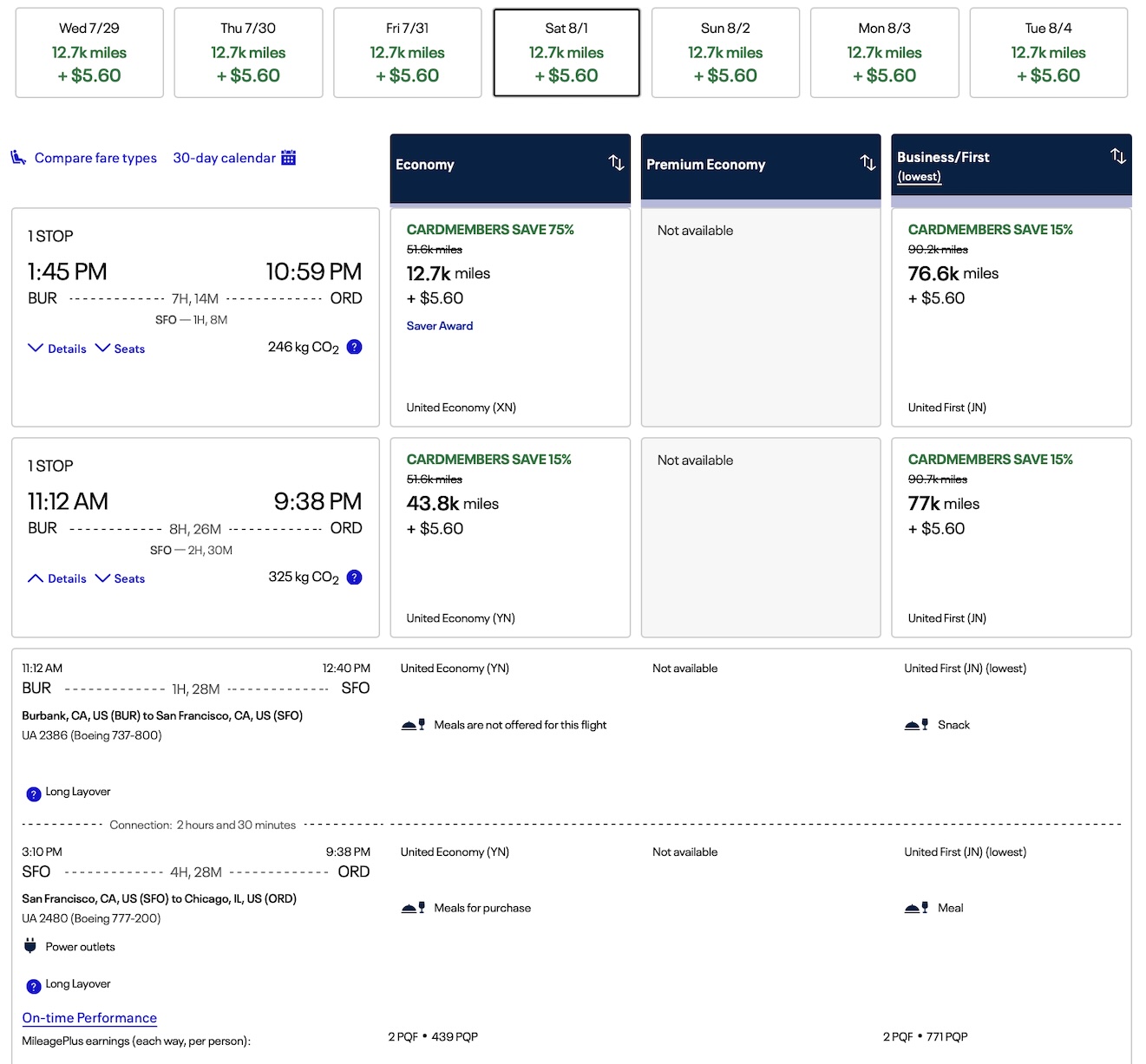
I had to fly from Burbank (BUR) to Chicago (ORD) and wanted to book on United via San Francisco (SFO) in order to get a lie-flat from SFO-ORD. The price was 43.8K miles in economy class for the itinerary I wanted:
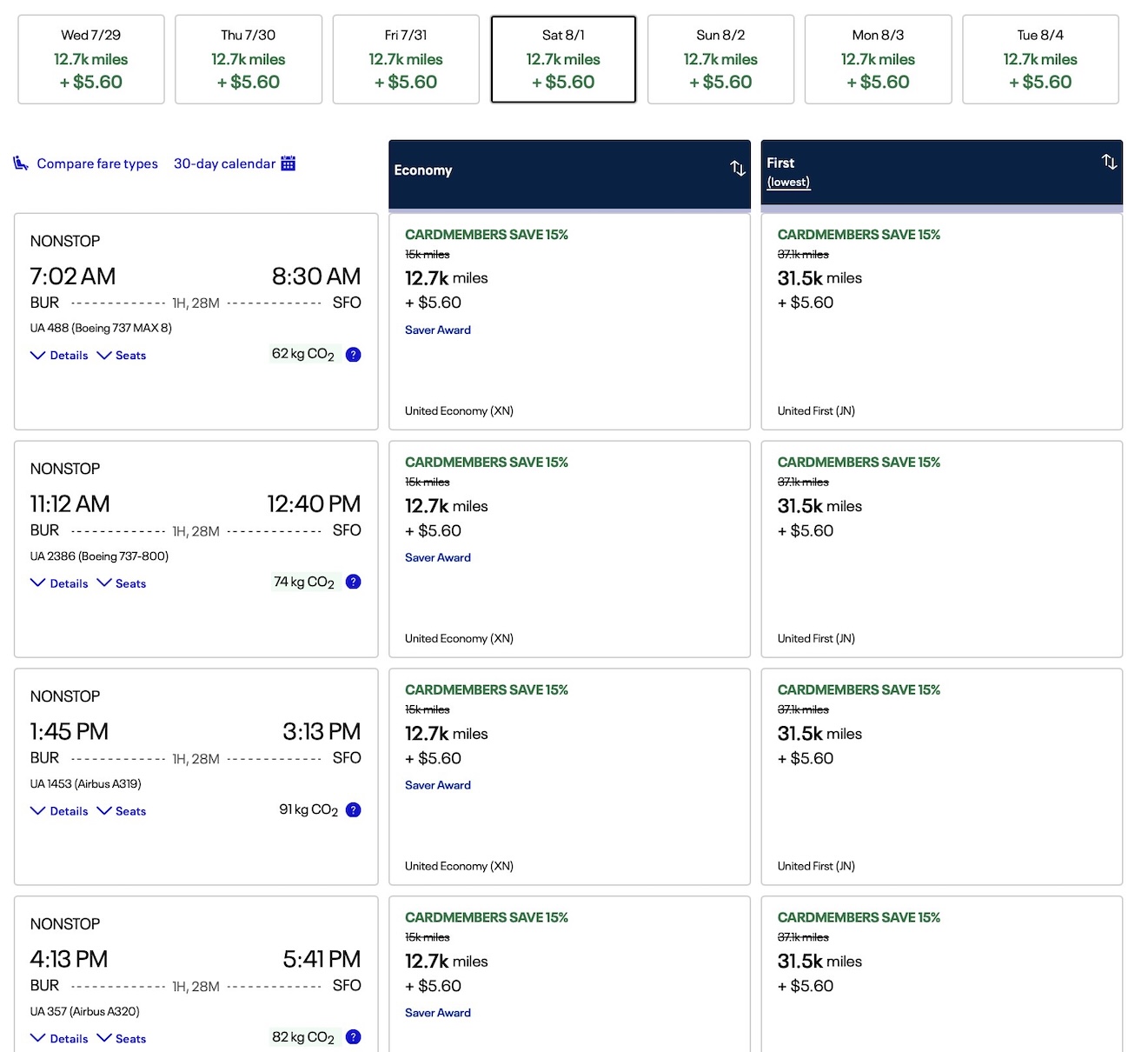
But if I booked each flight separately (which I ultimately did), there was saver space. BUR-SFO was 12.7K miles:
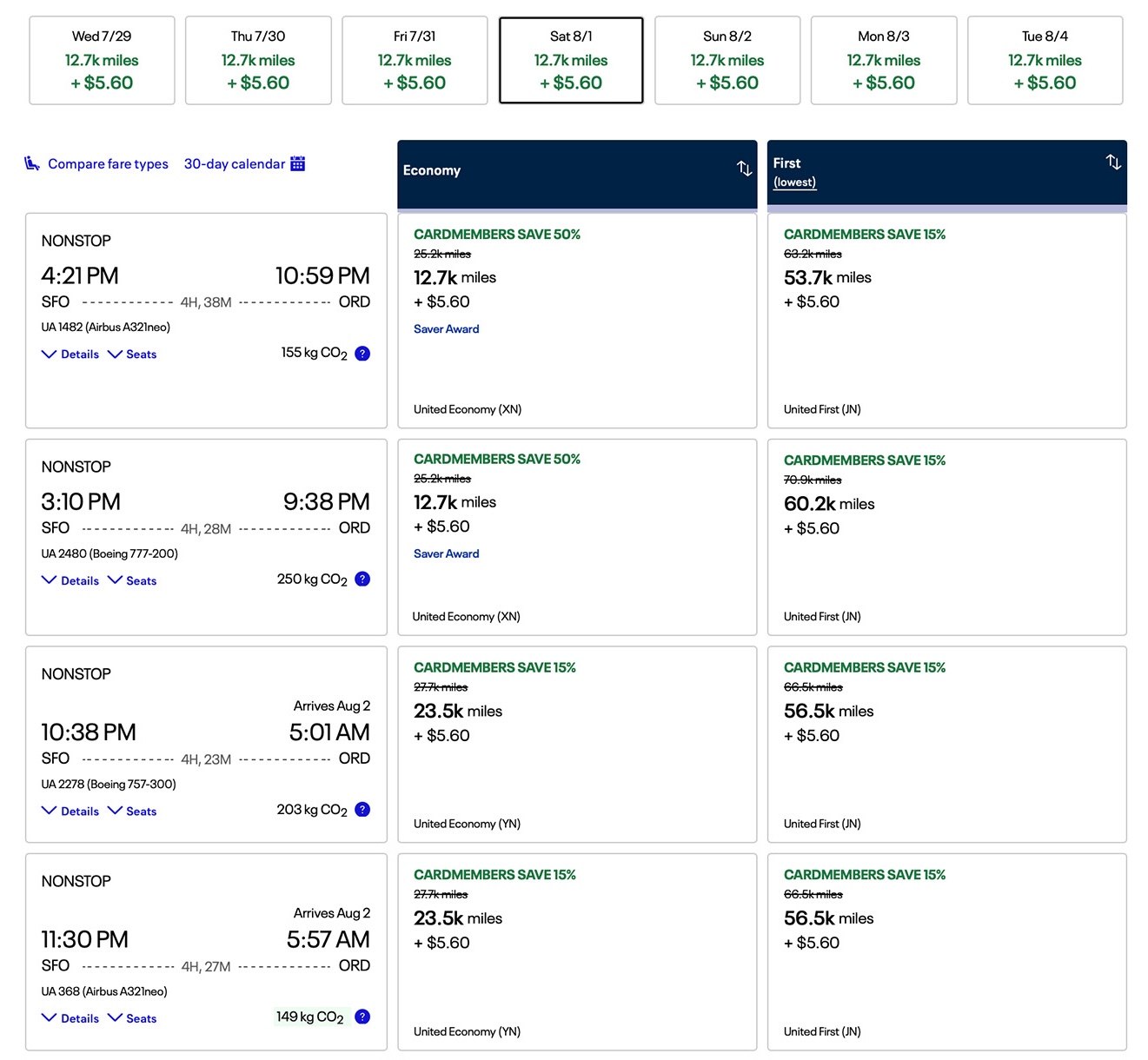
and so was SFO-ORD:
My understanding of United’s fare logic is that if there is X (or XN) space on both flights, and it is a published routing (and BUR-SFO-ORD is certainly a published routing), it should price as a single award…i.e., both segments should have priced at 12.7K miles total.
But instead, when booking together there was no X or XN space, hence the “reverse married segment” logic. Thus, the two flights booked separately were 12.7 + 12.7 =25.4 while if booked on a single PNR the same flights on the same dates at the same time were 43.8K miles.
Odd, ins’t it? And a little disturbing if United will start pricing some (if not all) domestic awards additively. Part of me thinks this was a glitch since you can see the screenshot above there was a later BUR-SFO-ORD combo with XN that priced at the expected 12.7K.
I say “expected” because United no longer publishes award charts, so any discussion concerning pricing is more about patterns rather than any published rubric.
CONCLUSION
I realize this post was a little technical, but I hope it was clear…the bottom line is that United seems to be pricing some award additively, where two segments might have “saver” award space (X or XN) when booked separately, but not when booked together, even when the combined flights form a valid routing.
So mark this as developing, but it is not a comforting trend.






I could also be nome of the above, but customer specific dynamic pricing which UA is actively deploying. Look for a price and what you get is based on your profile with them. Try again not much later or incognito and you get a different price, Have someone else look at the same time, different price.
At this point, I just expect the enshitifying to intensify. It’s a clear sign that the overall economy is struggling. Whether its fuel prices or stagflation, no bueno. And when the tide goes out, we get to see who’s wearing a bathing suit (and who isn’t… *raises eyebrows*)
All airlines are severely testing loyalty. Now, few miles are earned except on the most expensive fares. Award levels are way up. Since the pandemic started in 2020, I entered the burn mode. Roughly 90% of my travel have been award tickets. I lost all elite status, previously having elite status on multiple airlines.
So far,
United: all usable miles burned (which means less than 20k miles)
American: 60k miles left
Delta: all useable miles burned
Southwest: all useable miles burned
Alaska: still a large amount to be burned
I’ve never heard this called “compound pricing”, isn’t it just a corollary of married segments? City pairs are always evaluated separately for which fare buckets the airline is willing to make available: they’re willing to make X available BUR-SFO or SFO-ORD, but they’re not willing to make it available BUR-ORD, even if it’s made up of those same flights. I always thought married segment logic worked both ways, certainly has for paid fares.
And it’s not really additive, right? You could have booked a fare BUR-ORD in X for 12.7k on one ticket at a different time, and in that case UA didn’t add cost. But on the specific flight combination you wanted, UA was only making Y available for 43.8k. They didn’t take the X fares and add something on, it’s a completely different fare.
You ended up doing end-on-end ticketing for a fare United was not willing to offer on the flights you wanted. Officially that violates United’s terms, but I think you knew the risks.
Fortunately, UA is not adopting “compound pricing” for multi-stop itineraries. Instead, the airline has introduced a new tiered fare structure for its premium cabins (Polaris and Premium Plus) on long-haul international, transcontinental, and select Hawaii routes, dividing them into three tiers: Base, Standard, and Flexible, similar to the unbundled pricing of basic economy tickets.
So, if you notice unusually high or “additive” prices when creating a multi-city itinerary with UA, it’s usually due to the following factors:
* Illegal fare routings: When you combine specific cities manually via the multi-city tool, the system checks for a unified “through-fare” rule. If no unified rule exists for that exact sequence, the system defaults to pricing each segment in the highest, unrestricted fare classes (like Y or J class), drastically inflating the cost.
* Combining restrictions: Major airlines typically prevent you from combining their lowest and most discounted fares on multi-city or multi-stop tickets. To get the lowest available fare, you’re often forced to purchase the tickets separately, as one-way journeys.
* Dynamic reward pricing: UA uses a dynamic reward system without a fixed scale, so the number of miles required for complex, multi-stage journeys fluctuates considerably based on real-time demand.
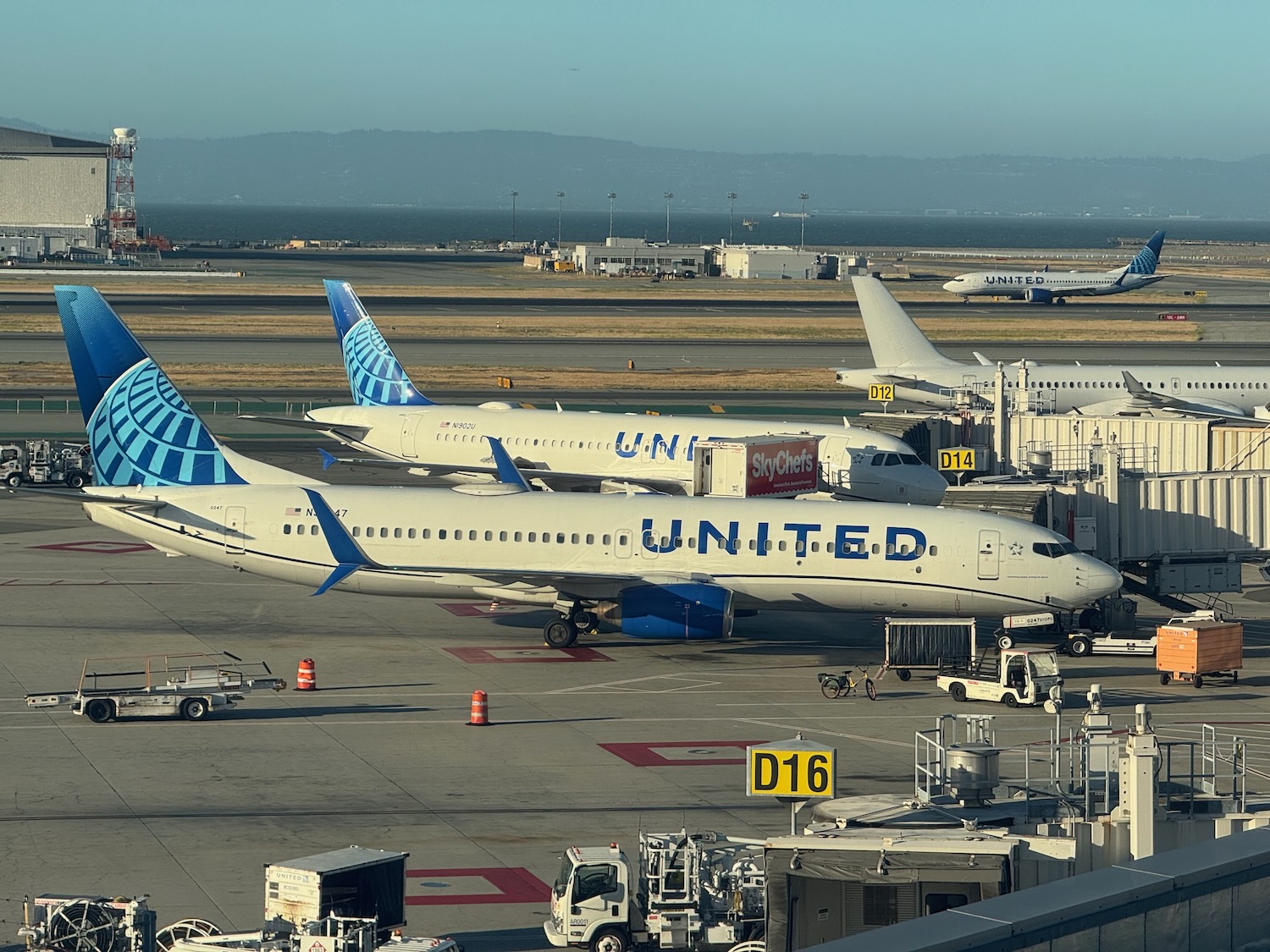
For aviation enthusiasts → The UA jet prominently featured in the article’s photo is a B737 MAX 9. The 0.4-year-old aircraft is currently parked at IAH.
Matthew – on your screenshots with cardmember discounts…… What specific card do you use for United? Thanks.
Club card.
It could be worse than that. The Avios airlines all price awards by the segment- in other words, punishing pax for their loyalty to an alliance which has fewer airlines and routes (and consequently fewer direct flights) than the competition.
As Virgin Atlantic benchmark most everything against whatever’s going on at BA, their partner awards copy the Avios logic… and AFKL seem to be doing exactly the same thing with partner redemptions ever since they got rid of their award chart.
Married segment logic may not be customer-friendly, but the connection penalty is a conscious decision to actively antagonise customers and insult their intelligence.
As others said the price can be higher or lower than what “you expect” esp since it’s dynamic.
Married segments (also known as journey control) affect the available inventory on multileg journeys. For example, there can be X space avail A-B, B-C, and also A-B-C. Or perhaps not avail on A-B-C. It says nothing about the pricing on the thru fare. I would say the only certainty is you can always get the total by the sum of the parts (end on end ticketing) but you may need to purchase separately.
Typically married segments are used to open up discounted space on the thru fare but the opposite can happen too!
I have noticed an interesting situation with BA redemptions recently. It’s not the same as this, and hard to explain in a short comment, but the end result is me booking two separate segments instead of one booking with a change of planes at the stopover.
If you do a multi city search, and select the flights, do you still get the higher pricing?
I seem to recall if it doesn’t offer the connections I want and I find my flights via mult-city, it often prices the segments separately, i.e. it’s not pricing it as a single fare unit.