
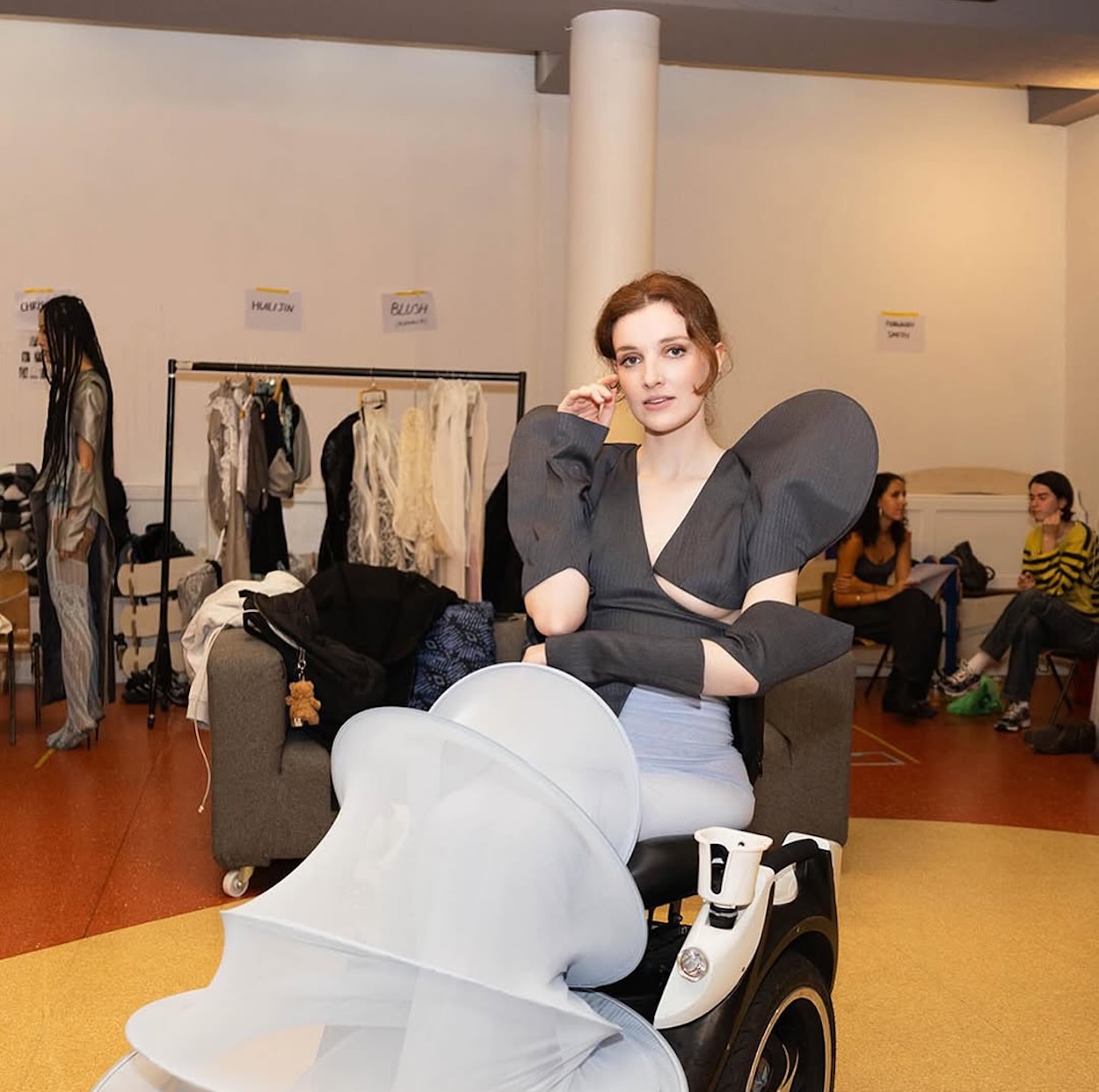
A disabled model says British Airways refused to let her fly from New York to London because cabin crew could not help her use the bathroom or evacuate her in an emergency. This is a difficult story where dignity, access, safety, and the limits of a flight attendant’s job all collide.
British Airways Denies Disabled Passenger Boarding Over Lavatory Assistance, Raising Difficult Questions
A disabled model and inclusion advocate says British Airways refused to allow her to fly from New York to London because she was traveling alone and cabin crew could not help her get to the lavatory or evacuate her in an emergency.
The passenger, Samanta Bullock, is a wheelchair user who had been in New York for a fashion show and a United Nations conference related to disability rights. She says she had booked her British Airways flight nearly two months earlier and had expected to travel home independently, as she says she has done many times before.
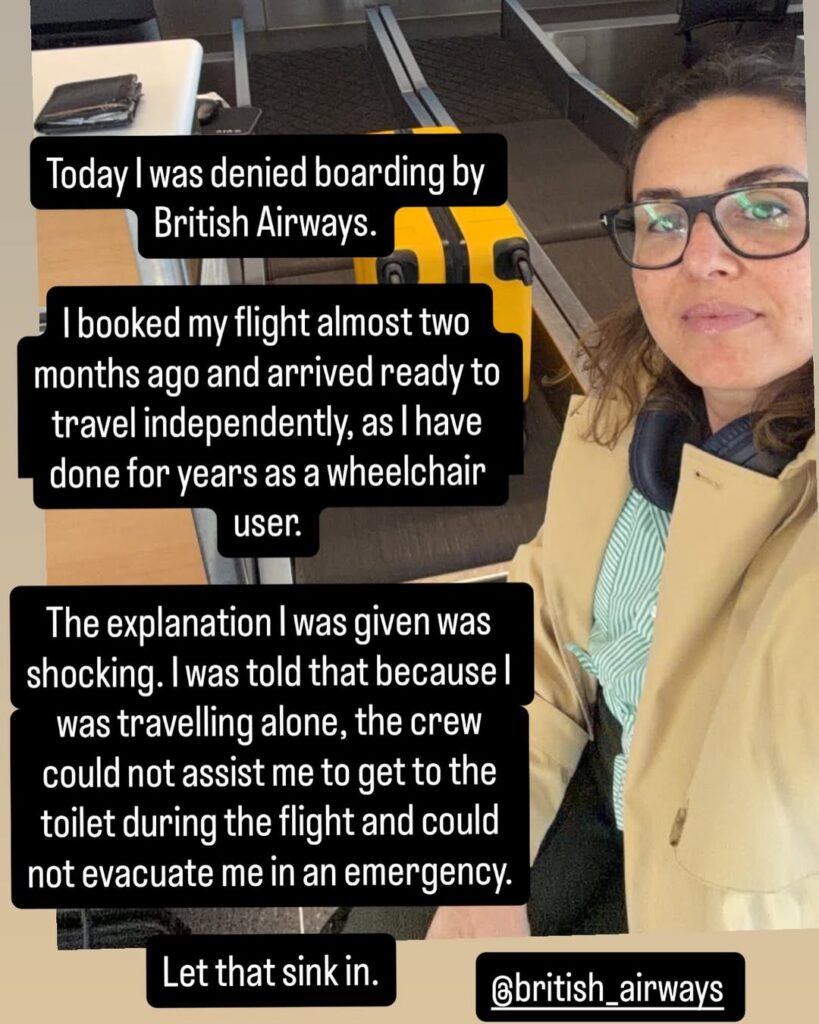
Instead, according to Bullock, she was denied boarding at New York JFK after being told that because she was traveling alone, the crew could not assist her to the toilet during the transatlantic flight and could not evacuate her in an emergency.
This may have been a rogue agent in New York. British Airways has only said that it is looking into it:
“We are sorry for our customer’s experience and are urgently looking into what happened. We remain in direct contact with the customer while we review the circumstances.”
Bullock ultimately traveled home on American Airlines, though she says she was also asked whether she could get to and from the lavatory on her own.
This is a hard story to write about because two things can be true at once.
Disabled travelers deserve dignity, access, and the ability to participate in life, work, and travel without being treated as a burden. At the same time, flight attendants are not personal care attendants, and there are valid questions about what cabin crew can safely and reasonably be expected to do in a lavatory or during an emergency evacuation.
The Legal Issue Is More Complicated Than It First Appears
Because this involved a flight departing the United States, U.S. disability law matters.
The Air Carrier Access Act applies to flights to or from the United States, including foreign airlines operating those flights. The U.S. Department of Transportation says that once a passenger with a disability has boarded, airlines must provide assistance, if requested, including moving to or from the lavatory with an onboard chair.
That is huge. An airline cannot simply say, “You use a wheelchair, therefore you cannot fly alone.” But there is also a limit. DOT guidance makes clear that airlines are required to provide assistance within the cabin, but not “extensive personal services” that include help inside the lavatory (i.e. transferring onto the toilet, wiping).
British Airways draws a similar line on its own website. BA says the majority of its aircraft offer accessible toilets. It also states:
“Please remember that you will need to be able to look after your personal care in the toilet. Our cabin crew won’t be able to help with this.”
BA also says passengers using the onboard wheelchair must be able to lift themselves from their seat onto the wheelchair or travel with a companion who can help.
That distinction matters and seems to be in accordance with U.S. law. Helping a passenger move to or from the lavatory using an onboard wheelchair is one thing. Helping a passenger inside the lavatory with clothing, positioning, cleaning, or other intimate care is something else entirely.
Compassion Does Not Eliminate Safety Questions
I want to be sensitive here because disabled travelers face indignities that most of us never even think about.
Airline travel is already stressful. For wheelchair users, it can involve damaged mobility devices, delayed assistance, inaccessible lavatories, humiliating transfers, and a constant fear of being treated as a problem rather than a customer.
Airlines, and society itself, has a long way to go toward treating such folks with dignity.
But compassion does not eliminate the safety question.
If a passenger cannot transfer to the onboard wheelchair without physical lifting, manage personal care in the lavatory, or evacuate without assistance, the airline is placed in a difficult position. The passenger’s right to travel is real, but so is the airline’s obligation to operate safely.
British Airways’ conditions of carriage say the airline may require a passenger to travel with an attendant if it is essential for safety or if the passenger is unable to assist in their own evacuation or understand safety instructions.
While this cannot be used as a lazy excuse to exclude disabled passengers, it also cannot be dismissed as unlawful discrimination every time it is raised. It seems to me there has to be an individualized assessment, not a blanket rule, and I don’t have enough facts to know what side to fall on here.
Flight Attendants Are Not Personal Care Attendants
As I mentioned above, I do not think flight attendants should be expected to provide intimate personal care in an aircraft lavatory.
I have helped loved ones with this kind of care. Nothing fazes me anymore. But that came from love, necessity, and relationship. It was not a job requirement imposed on me at 35,000 feet while also being responsible for the safety and service of hundreds of other passengers.
Flight attendants are trained for safety, service, emergency response, medical events, evacuations, security issues, and cabin management. They are not paid enough, trained enough, or staffed enough to become in-flight personal care attendants.
There is a line between assisting a passenger to the lavatory and providing hands-on toileting care inside the lavatory. That line exists for dignity, safety, liability, and basic human boundaries.
Bullock argues that if disabled passengers are expected to travel with a companion, they are effectively being charged double for the same freedom others enjoy. That is a powerful point.
Traveling with an attendant can be expensive. Furthermore, not everyone has a friend, spouse, caregiver, or assistant who can drop everything and fly across the Atlantic.
At the same time, if a passenger knows they cannot transfer, cannot use the lavatory, or cannot manage personal care without assistance, traveling alone on a longhaul flight creates predictable problems. It also places flight attendants in a position they may not be equipped or permitted to handle.
I do not want a world in which disabled travelers are told to stay home. Quite the opposite. But independence also requires planning around the reality of the aircraft cabin we have today, not the accessible cabin we wish existed. On a longhaul flight, bathroom access is not a minor detail. It is central to whether the trip can be completed safely and with dignity.
Where British Airways May Have Gone Wrong
Even with all that said, British Airways may have mishandled this.
If Bullock had provided advance notice, had traveled independently before, and had a plan for managing her needs, then denying boarding at the gate would be a serious failure. If the problem was merely that cabin crew did not want to assist her to the lavatory using the onboard wheelchair, that would appear difficult to square with U.S. DOT rules for flights departing the United States.
If the concern was evacuation, BA should be able to explain exactly what individualized assessment was made and why she was deemed unable to travel safely without an attendant.
CONCLUSION
British Airways is investigating after disabled model Samanta Bullock says she was denied boarding on a New York to London flight because she was traveling alone and cabin crew could not help her use the bathroom or evacuate her in an emergency.
I have deep sympathy for Bullock. Disabled passengers deserve dignity and access, and airlines cannot casually deny boarding based on disability. If British Airways failed to follow U.S. disability rules, it should be held accountable.
But I also have sympathy for flight attendants who are placed in impossible positions. Helping a passenger move to the lavatory is one thing. Providing intimate personal care inside the lavatory is another. Flight attendants are not paid, trained, or staffed to do that.
This story should not become a simplistic debate between “the passenger is entitled” and “the airline is heartless.” The reality is that modern air travel still has not figured out how to provide true accessibility while respecting safety, dignity, and the limits of cabin crew duties (and to be clear, there may be no viable solution).
What do you think about this incident?
Hat Tip: PYOK




A well balanced story…so many considerations. I’d like to read BA’s response, but I’d also be curious to hear from the passenger as to how she handled such issues on past flights.
Agreed, Matt managed to thread the needle here.
Any traveller is entitled to use the toilet. I don’t know why she would need a bathroom, unless she wanted to take a bath!
Myself as disabled and use a walker at times to get around feel that it’s my responsibility to be able to travel without having flight attendant aide me. I used to work in the medical field and would request patients to bring a care giver to help them get on/off exam tables. Too many injuries to medical staff in helping patients when they really should have a caregiver with them for their appointment. I feel the same with traveling the flight attendant have to attend too many passengers. It’s also for their safety as well.
I had a 30 year career as a nurse and I definitely do not think flight attendants should have to provide personal care or lift and transfer someone to the toilet . They could potentially have a serious back injury and leave themselves open to false accusations . Generally anyone who is a paraplegic would use an indwelling catheter when traveling. The other option is a travel companion but airline toilets are too small to accommodate a wheel chair.
They shouldn’t provide personal care. Nor were they asked to. There are far too many assumptions by commenters and the author of the article on this passenger’s abilities. If planes were designed better so one wasn’t trapped if they couldn’t walk, the passenger wouldn’t require anyone’s help.
The passenger did not need help ‘inside’ the bathroom. The airline employee just assumed she did. The airline is required to provide the onboard wheelchair to assist someone from their seat to the washroom as the plane’s design (ie: width of the aisle) does not accommodate the passenger’s own wheelchair. The author of this article has made their own assumptions and missed key facts in this story.
As someone who also uses a wheelchair and flies regularly, being forced to give up your independence simply to fly and then be berated for it is ridiculous and dehumanizing. If passenger trains and boats can be accessible, then airlines should as well.
“The passenger did not need help ‘inside’ the bathroom.” This is the first I heard of this case. So how do you know your assertion is true? I assume you have a reference to more data and have not made you”own assumptions and missed key facts in this story.” So, maybe a link for us?
Here you go: https://www.instagram.com/p/DZkBv-LCBkZ/
Most people in wheelchairs work and go about their day without assistance – they just can’t walk. The only difference here is that their mobility devices are taken away from them when they board a place. Thus they are dependent on someone to get an onboard wheelchair and push them ‘to’ the toilet on it. It’s already an awful experience for the passenger … without everyone assuming they need someone else to take care of private business as well.
Thanks for the link. But, nowhere in that link does she address the issue that has been central to many of us: does she need help inside the lavatory. I’ve travelled with a college chum who has needed to use a wheelchair for decades. He has full upper body capabilities, unlike the woman here who is quadriplegic. So, no Matthew and I are not assuming facts not in evidence. We question if she needs help inside the lav and none of us knows.
She states in the comments in that link that she does not. That the issue is the airline (and now everyone else) simply assumed she does.
TL, I read here post but not the 2438 comments. I’ll trust you she addressed that issued as you reported. Thus, BA really screwed up.
…the woman isn’t a quadriplegic? For someone who complained about people making assumptions, it’s pretty wild to see someone in a wheelchair and assume they need that level of help. Like where are you getting the information that she needed help inside the bathroom, it was a pure hypothetical the author threw out to downplay discrimination. She flew over to the US, so it’s not like this was a deal breaker before, but most importantly: the question used to deny her boarding was not a question of extra assistance, it was a question that violated the law. “Can you get yourself to the lavatory” is not a legal basis to deny someone boarding over, it’s discrimination. If they were worried about intimate care or her ability to transfer on her own, why were those not the questions that were asked?
Nope, I didn’t make an assumption. I screwed up worse. I read “I became paraplegic” in her insta post of 15Dec2025 and internalized it as “quadra.” So, now that this is clear, yes BA screwed up.
I am confused. Who did she get to New York in the first place ?
The article says ” Going home on American..” She then originated in London, no ?
Also, agreeing with Mary; I was a RN when I went to work as a flight attendant for Pan Am.
Flight attendants cannot assist in lavatory activities but people who are disabled to this persons extent are familiar with appliances and products such as an indwelling catheter to aid them in the journey.
Just to clarify, not all paraplegics use devices to urinate. There are many people with incomplete injuries who are really put in a difficult position by not being able to access facilities. People should not be forced to dehydrate themselves to such an extent just because plane design is awful and crews assume things they shouldn’t.
Model and disability advocate Samanta Bullock became a paraplegic following a shooting accident in 1992 when she was 13 years old (some sources refer to this age as 14). The traumatic accident was caused by a bullet from her father’s shotgun, which severed her spinal cord and damaged her internal organs. Prior to the incident, she had been working as a professional model in Brazil and feared her career was over. Despite the life-altering event, she later successfully pursued both competitive wheelchair tennis and global adaptive modeling. More power and best of good luck to her!
Refresh/remind me. Wasn’t there a story here several years ago about a female FA (Asian carrier) who sued her employer (for PTSD) for having to help an elderly “handicapped” male who insisted she wipe his behind, pull up his pants, etc ??? The story was totally disgusting, not sure how she ended up getting so involved but apparently he got beligerent/ loud, etc. Does anyone remember this ?
Yes, I have compassion for people who are genuinely handicapped/ incapacitated but with a traveling companion should be the only way they can travel by air.
Oh, I remember that…
The only time in my 17 years of blogging that I’ve ever used a swear word in the headline:
https://liveandletsfly.com/disgusting-eva-passenger/
This dirtbag should have been pushed off the aircraft…at 40K feet.
I wonder if she realises that in the event of an emergency evacuation she’ll be the last pax to leave the aircraft?
Yes, she is aware. This is like saying “I wonder if tbe fat person knows there are weight limits…” or “I wonder if smokers know smoking is bad for their health.” Trust me, disabled people know what it means to be disabled.
I do wonder what expectations are for FAs with those who cannot walk in such cases. If she were on JAL 516, would FAs be expected to go back in the burning plane to somehow drag/carry her to safety? Remember, evacuation took 11 minutes. But, nobody on that flight took hand luggage off.
We used to have this lamp that we had to smack every once in a while to get to operate correctly.
Wonder if thatll work for this lamp too
This is a classic example, both in the treatment of this model by airline staff and in the wiring of this piece, of the shameful practice of nondisabled people assuming they know what disabled people need instead of listening to disabled people about what they do and do not need. The model said she did not need assistance. End of story, for everyone. The paternalism of the airline employees and the author of this story assume that the disabled person either does not know what she needs or is lying about it. Neither is true.
There are many assumptions being made, both in this article and by British Airways. I’m a wheelchair user who travels solo quite often. Did this traveler indicate she needed help inside the lav? Frankly, most airlines don’t even have accessible lavs, so I never make an assumption I’m going to be able to use the restroom onboard. I’ve flown from London to New York without using the lavatory at all. As far as helping a passenger in an emergency, well, that’s a pretty shitty response. As a human being, I wouldn’t be comfortable saying I wouldn’t help another person in an emergency. Also, literally anyone could need help in an emergency. Should folks with anxiety not be able to travel alone because they might freeze up or have an anxiety attack and, therefore, need assistance? Should children not be able to fly in the event that their adult becomes incapacitated and unable to assist them? As a disabled traveler, I understand there are risks for me that others may not have. That doesn’t mean that someone else should get to decide that I don’t deserve the dignity of being able to make the decision on taking that risk, just like every other paying passenger.
Beautifully said.
Look I get the issues but she has flown alone plenty of times. Logically that means she does not need assistance in the bathroom. BA was wrong here. Also I don’t care how BA feels about her traveling. The moment she has been removed from her home country airlines in general have an obligation to return her home not strand her in a foreign country.
Seems like any time something like this occurs the passenger is not in their home country and is trying to get home.
We don’t know the facts, but why not spend half the article discussing a humiliating imagined scenario that makes the disabled passenger look unreasonable?
Ableism is rife, as perfectly demonstrated by this article and the comments section.
I tried to take very measured approach but this situation is about far more than this particular passenger.
But yet, you don’t write it that way.
Your very first sentence states:
“A disabled model says British Airways refused to let her fly from New York to London because cabin crew COULD NOT HELP HER USE THE BATHROOM or evacuate her in an emergency.” (capitalization is mine)
Exactly. She doesn’t need help using the bathroom, just getting to it.
Amen. The leaps and assumptions that were taken in this story were so ableist and ignorant.
Oh please.
She arrived “…ready to travel independently, as (she) has done for years as a wheelchair user.”
The photo accompanying this article includes a quote from Ms. Bullock stating that she has traveled independently for years. Why the author went off on a tangent about intimate care with personal hygiene is beyond me. I saw nothing in the article that indicated Ms. Bullock had requested any assistance beyond the norm in her previous travels.
Because I’m speaking about this issue in general – it goes beyond Ms. Bullock.
But as I said, if Ms. Bullock was able to care for herself, then she was improperly denied boarding. Period.
Sorry if I’m being too blunt in discussing a sensitive topic, but aren’t FA’s trained in how to drag my unconscious body off a burning aircraft? Does BA plan on letting people who can’t self-evacuate burn to a crisp, and that’s why they don’t let the mobility impaired travel alone?
Matthew,
Andy 11235 makes a good point here. What are airline evacuation procedures for quadriplegics or other disabled persons on all or various airlines ? – maybe worth an article on this topic ? I get it, unfortunately, even able-bodied will lose lives if a horrendous accident occurs.
My husband was a gate agent for many years (as was I) and we discussed this many times. He did have an experience with a quadriplegic who chose to fly and and was fully aware (when advised delicately by my husband) that should there be an emergency evacuation, there was no guarantee that FA help could be provided in a timely manner. The man was so gracious and fully understood. The thought of all this is very sad – really, are there any general procedures in this case when FA’s are trying to get out hundreds of other passengers?