
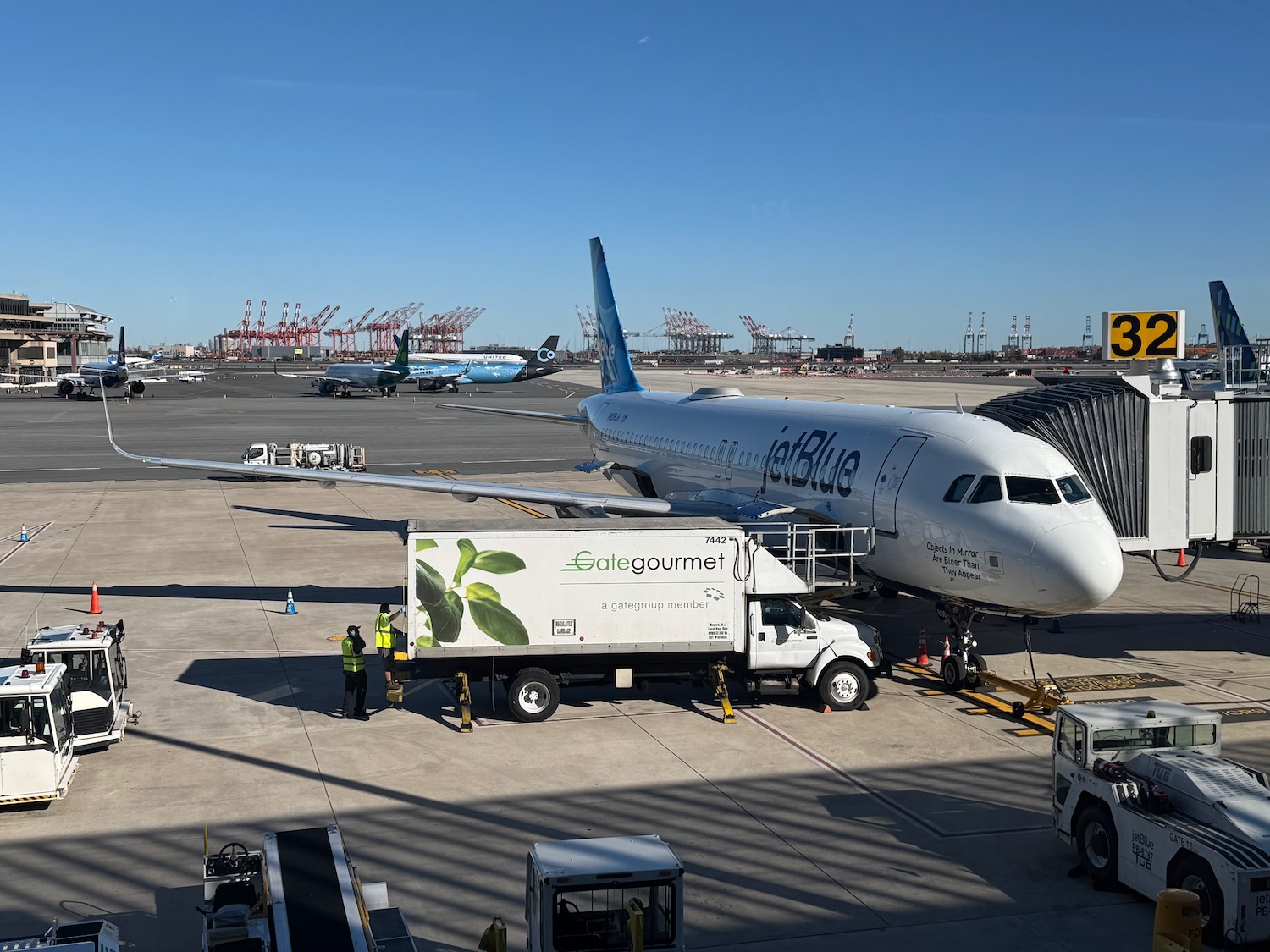
JetBlue is pulling down even more Newark flying, and the message is clear: Newark does not work for JetBlue any more than JFK worked for United. That has implications far beyond a few leisure routes that JetBlue is axing: I sense it is part of a strategy that, at the very least, makes a JetBlue-United merger more tenable.
JetBlue Pulls Back From Newark, Strengthening The Case For United Tie-Up
JetBlue is cutting more routes, and Newark (EWR) is taking a particularly hard hit.
The latest reported cuts include Newark service to:
- Aruba (AUA)
- Cancun (CUN)
- Punta Cana (PUJ)
- Santo Domingo (SDQ)
- Tampa (TPA)
JetBlue is also cutting Hartford (BDL) – Tampa, Orlando (MCO) – San José (SJO), Providence (PVD) – San Juan (SJU), and all flights from Manchester, New Hampshire (MHT).
This is the latest sign that JetBlue is moving away from marginal outstations and toward places where it can actually build a defensible network. And Newark, despite being a massive New York-area airport, is not that place for JetBlue.
Why Newark Does Not Work For JetBlue
The problem is that Newark is United’s fortress hub. United has the scale, the corporate contracts, the frequent flyer base, the premium traffic, the lounges, the international network, and the schedule utility to make Newark work.
JetBlue has a nice onboard product, but a nice onboard product is not enough when you are competing against a hub carrier with far more frequency and far more revenue depth.
That is especially true at a high-cost airport like Newark. It is hard to make money flying leisure-heavy routes if the airport cost structure is high and you do not have enough premium or connecting revenue to offset it. A $109 fare to Florida or the Caribbean sounds great to consumers, but if the airport costs, aircraft utilization, crew costs, and competitive pressure are too high, the route does not work.
JetBlue can compete at Newark around the edges, but it cannot even come close to competing with United at Newark.
And that brings us to the obvious comparison.
United Could Not Make JFK Work Either
This is the mirror image of United at JFK.
United repeatedly tried to make JFK work without enough scale. It had premium transcontinental flights. It had brand recognition. It had MileagePlus members who wanted JFK. It had a great product on some routes. But without enough slots, United was always a niche player.
Eventually, United walked away from JFK.
That was painful and arguably strategically shortsighted. But the underlying lesson was clear: in the New York market, being present is not the same thing as being relevant.
United was present at JFK. It was not relevant enough.
JetBlue is present at Newark. It is not relevant enough.
That is why these Newark cuts make sense.
JetBlue Is Choosing Fort Lauderdale
In this case, it’s not like JetBlue is simply sinking. As Cranky Flier has pointed out, JetBlue is building Fort Lauderdale into something much closer to a true hub. Historically, JetBlue has not been a classic connecting airline. It has been more of a point-to-point carrier with strong positions in places like New York, Boston, and Fort Lauderdale.
But Fort Lauderdale is different now and being used as a connecting point…there’s even flight banking going on.
With Spirit gone, JetBlue has a rare opportunity to become the dominant carrier at a major South Florida airport with strong leisure, visiting-friends-and-relatives, Caribbean, and Latin America traffic. That is far more interesting than trying to fight United at Newark with a scattered route map and limited scale.
With aircraft are scarce, JetBlue should put them where it can win. Newark is not where JetBlue can win. Fort Lauderdale may be.
Still, The Newark Pullback Is Awkward
The awkward part is that JetBlue is now in bed with United through the Blue Sky partnership.
Under that arrangement, United is returning to JFK with access to JetBlue slots, while the airlines exchange Newark timings and add reciprocal loyalty benefits. Customers will eventually be able to access many benefits across both carriers, and United customers can now earn and redeem miles on many JetBlue flights.
Officially, the airlines remain independent. They will still price and manage their own networks.
But when JetBlue cuts Newark routes where United is already strong, it naturally raises eyebrows. It may be perfectly rational network planning. But it may also be exactly what you would expect when two airlines are increasingly aligned: JetBlue focuses where it is strong, United focuses where it is strong, and the overlap diminishes…dare I say, deliberately?
That is not necessarily nefarious or a sign of collusion, but…
This Makes A United – JetBlue Merger More Likely, Not Less
I have said before that I think a United – JetBlue combination remains a strong potential outcome, and these moves only reinforce that view. The JetBlue debt problem is still a problem and that may indeed make a merger insurmountable, but I’m not foreclosing the possibility.
JetBlue has a great brand, a loyal customer base, a strong New York presence, a valuable position in Boston, a growing Fort Lauderdale opportunity, and a product that many passengers genuinely prefer. But it also has a structural problem. It is too large to be a boutique carrier and too small to match the network breadth of the Big Three. It’s cost structure is too high to be a budget carrier.
That shaky middle ground is the reason why JetBlue continues to lose money.
When it comes to merger partners, American still makes the most sense to me, but it is choosing to increase collaboration with Alaska Airlines instead. Already strong in NewYork and Boston, Delta does not need JetBlue. Alaska does not appear interested as it focuses on its own growth with Hawaiian Airlines. United, meanwhile, has the clearest strategic fit.
United wants more relevance at JFK. JetBlue wants more global relevance and a stronger loyalty proposition. United has the longhaul network JetBlue lacks. JetBlue has the JFK slots and East Coast leisure network United wants. The Blue Sky partnership already gives both sides a way to test the commercial logic.
We know a merger will face serious antitrust scrutiny, especially in New York and Boston. If Democrats win the House and/or Senate in November, there would be more political noise and more hearings. But Congress does not approve airline mergers. The real action would be at Department of Justice and Department of Transportation, and the case would depend heavily on market conditions at the time. I don’t see it as a problem.
The problem is the debt, not the regulatory burdens.
Are Consumers Hurt Or Helped By This?
The consumer angle is complicated.
On one hand, fewer JetBlue flights from Newark means less competition against United. That is not great for fares. Newark travelers lose choices, and United becomes even more dominant. It’s bad news for those who fly JetBlue out of Newark.
On the other hand, JetBlue wasting aircraft in marginal Newark flying does not help consumers if the routes are not sustainable. A stronger JetBlue in Fort Lauderdale may be better than a weaker JetBlue spread too thin across expensive airports where it cannot win.
Consumers benefit from competition, but competition has to be economically durable. JetBlue cannot be everywhere. It has to choose. Right now, it appears to be choosing Fort Lauderdale over Newark and that makes a lot of sense.
CONCLUSION
JetBlue’s Newark cuts are not surprising. Newark is United’s fortress, and JetBlue lacks the scale, revenue base, and network depth to make it work there. In the same way United could not make JFK work without meaningful scale, JetBlue cannot make Newark work by dabbling around the edges.
The bigger story is what this says about JetBlue’s future.
JetBlue is concentrating where it has a real chance to build strength, particularly Fort Lauderdale, while its partnership with United gives both airlines a closer commercial relationship in the New York market.
That may be just a partnership for now. But I still believe a United – JetBlue merger remains a plausible and even likely endgame. The politics would be messy, especially if Democrats control one or both chambers of Congress, but the strategic logic is only getting stronger.
JetBlue cannot win Newark from United just like United cannot recreate JetBlue at JFK. I don’t think there was any collusion here, but I also think we may see even more reduction in route overlap in the months to come as JetBlue at least leaves open the option for a merger with United, knowing that the more overlap, the harder regulators will push back over a merger.
United has always wanted a Southeast hub and Fort Lauderdale could be it. A deal with American Airlines was never serious (to me), but a deal with JetBlue and growth in Florida, New York, and Boston seems quite reasonable.





New York Attorney General Letitia James and Massachusetts Attorney General Andrea Campbell are gonna be ready for battle if United Airlines tries to take over the east coast. See you in court, United.
Yeah kid bankruptcy court for B6.
Spirit & jetBlue had 13% of EWR market share. This is a windfall for United (60% EWR share) in NYC along with the SFO/LAX – JFK transcons coming in 2027.
United Airlines is not going to buy JetBlue. Other than slots and facilities at JFK, there’s nothing JetBlue has that’s worth UA picking up nearly $10 billion in debt, let alone the merger costs, for a company that hasn’t been profitable since 2019 and which the CEO flat out says won’t be profitable in 2026.
The gates and slots will come in the JetBlue bankruptcy auction.
Wasn’t there some chatter a while back about UA wanting to establish a hub in Florida?
Scott Kirby kind of mused about it a year or so ago, but said there weren’t enough gates in FLL that UA could get to make the a hub work like UA wanted.
Notice that UA just added some point-to-points from CLE to MIA and LAS. They already fly their only two non-hub flights CLE-FLL/MCO, and the new CLE routes may be a matter of crew and/or aircraft ability in that city, but they don’t seem to be rushing to fill the Spirit void in FLL.
what about an intermediate solution of Jet Blue joining the TransAtlantic JV and joining Star Alliance?
Jet Blue would be able to launch flights from FLL as part of the JV
Yeah, less competition isn’t great, but I’ll take less competition at one airport in a metro area with three already, if it means jetBlue continues to operate reliably at 2 of the other 3 (LGA and JFK). I also agree, Matt, that B6 should focus on BOS, JFK, FLL, and otherwise ditch anything that isn’t profitable. Fast. The P&W debacle, holding onto a320, etc. has been a real drag on the airline. If they can get the $150-250 million from P&W, refocus on a220 (far less CASM), and scale MINT (far more RASM), they’ll be in a better spot, fingers crossed.
A meaningful gift from one partner to another!
Bahaha… you got me, good doctor!
While rumors persistently circulate that B6 is exploring a sale with advisers targeting UA, AS, or WN as buyers, significant concerns and obstacles remain… According to airline industry reports, UA executives are deeply worried about B6’s substantial debt, which could reach nearly $9 billion. Although the current administration is perceived as more open to airline consolidation than in previous years, a full acquisition of B6 by UA would attract intense scrutiny due to their combined massive presence in the Northeast. Furthermore, experts suggest that UA might ultimately forgo a complete takeover. Instead, the company could instead consider acquiring some of B6’s assets (such as slots at JFK) or taking a minority stake of 10%–15% to maintain its alliance without absorbing B6’s debt.
It is 100% true that “Newark is United’s fortress.” Let us once again wish and hope that from that strong and historic fortress, a jetliner never takes off to carry out a flight like UA93 and fly directly into the most horrific coordinated terrorist attack in United States history!
#NeverForget
Newark Terminal C does have a commemoration to UA93. And, if you ever drive the Pennsylvania Turnpike all the way to Pittsburgh, it is worth the stop in Somerset County to pay respects to the heroes who fought back.
For aviation enthusiasts → The B6 aircraft featured in the article is an A320-200 (age: 13.7 years).
With Spirit demise, Jetblue would finally earn money due to Jetblue’s strength at FLL. Jetblue needs to expand FLL as fast as possible. This would mean cancelled low yield or unprofitable point-to-point routes, and move the planes and crews to FLL. I doubt Jetblue canceling Newark routes had anything to do with merger preparation.
UAL would want to sell more Mileage+ credit cards membership, and Boston has a large high income population. It is better for UAL just buying Jetblue’s BOS operation. Few anti-trust headaches.
And it was just a few years ago when B6 had a mint checkin area that opened with the new EWR terminal A. What a change and I wonder what that space is now.