
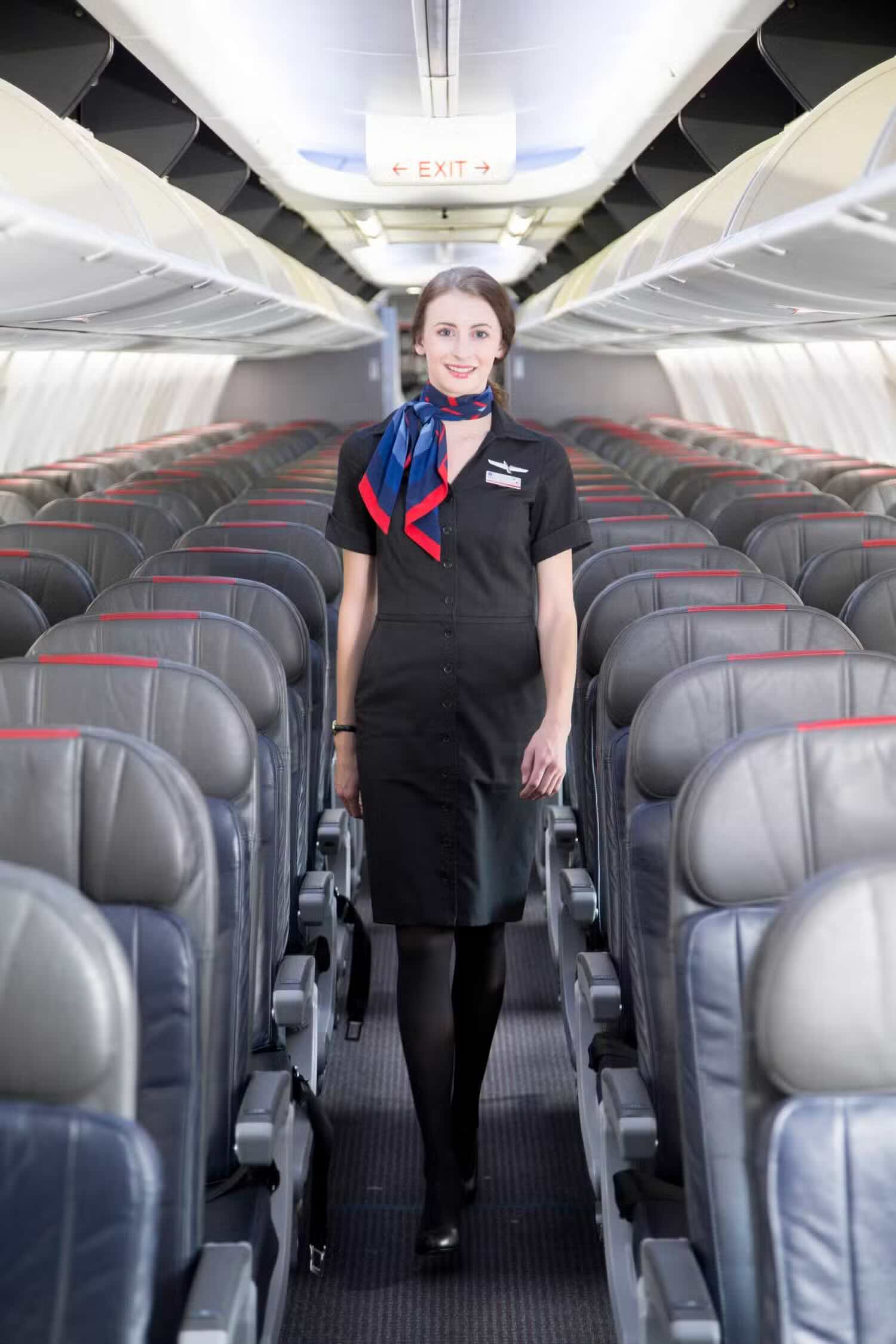
American Airlines is preparing cabins for landing earlier, a move meant to protect flight attendants from turbulence injuries during descent. I understand the safety concern, but I still think this is an overreaction that materially worsens the passenger experience, especially on redeye flights. However, there’s a compromise that I hope AA (and other carriers) will consider.
American Airlines Will Prepare Cabins For Landing Earlier – Is The Tradeoff Worthwhile?
American Airlines is changing its landing procedures, with flight attendants now beginning final cabin preparation at 18,000 feet rather than 10,000 feet.
That means passengers will be asked to raise their seats, stow tray tables, put away laptops, secure bags, and otherwise prepare for landing earlier than before. The goal is to have flight attendants seated and strapped into their jumpseats by the time the aircraft reaches 10,000 feet.
American is not alone here. Other airlines like Southwest Airlines and United Airlines have moved in a similar direction as turbulence injuries have become a greater concern, and the logic is not hard to understand. Descent can be bumpy and low-altitude turbulence can occur with little warning. Flight attendants walking through the cabin, bending over, reaching for bags, and checking rows are more vulnerable than passengers who are seated with seat belts fastened.
I do not want to see flight attendants injured. They already deal with enough nonsense onboard and should not be placed in unnecessary danger. But I also think this is a huge overcorrection.
For passengers, especially on redeye flights, this change matters. A lot.
On paper, we may be talking about only a handful of extra minutes. In reality, on an overnight flight, those final 15–20 minutes of recline can be incredibly valuable. If I am flying a transcontinental redeye and trying to maximize sleep, being forced upright earlier is not a small thing. It directly impacts the value of the flight.
In fact, one reason I have often preferred American Airlines redeyes to United Airlines is that the cabin did not feel quite as aggressively shut down before landing. I could rest longer, keep my seat reclined longer, and make the most of an already-too-short night in the air.
That advantage is now diminished.
A Better Compromise
The compromise seems obvious to me.
Let flight attendants begin their work pre-arrival duties if American believes that is necessary. Let them make announcements earlier. Let them collect trash, check bags, and complete their final safety duties before 10,000 feet.
But passengers should be allowed to remain reclined and have their laptop outs until the traditional double ding at 10,000 feet.
Yes, that means compliance would be partly on the honor system once flight attendants are seated. But so what? We already rely on passengers to follow instructions when crew cannot stand over every seat. Most people will comply once the signal is clear.
Forcing everyone upright far earlier than necessary feels like using a sledgehammer to solve a problem that could be handled with a more balanced approach.
If the aircraft is in rough air, then absolutely, secure the cabin early. But as a blanket rule on every flight, even in smooth conditions, it feels excessive. I’ve seen no actual numbers to suggest this change will materially reduce turbulence-related flight attendant injuries.
CONCLUSION
American Airlines (well, at the union representing them) wants flight attendants seated earlier during descent, and I understand the safety rationale. No passenger’s recline is worth a crew member being injured.
But requiring seats upright and cabins secured at 18,000 feet instead of closer to 10,000 feet is bad news for passengers, especially on redeye flights. Those extra minutes of recline and sleep are not trivial.
American should protect its flight attendants without unnecessarily degrading the passenger experience. Let cabin crew prepare early, but let passengers remain reclined until the 10,000-foot double ding unless conditions require otherwise.
That would be a far more reasonable compromise.
Do you agree with me or is more caution necessary?
image: American Airlines



in some cultures, personal compliance with safety measures could work but not in the US.
Ben has an article today about a FA that was knocked to the floor by turbulence long after most US FAs would have been in their jumpseats.
We as a society are punished because of the actions of a few.
Redeyes aren’t worth it if there is an alternative for lots of reasons.
Delta gonna start day-time TATL? (American, British, jetBlue, United, Virgin already do this on NYC-LHR…)
DL has done it on both JFK-LHR and CDG.
VS has a daylight JFK-LHR as do AA, BA and B6 from JFK as well as UA from EWR.
the real question is if DL returns to LAX-LHR, as rumored by some on the internet – although not sure how that or anything at LHR is related to this discussion.
Yes, “has done” but not anymore. Huh.
Oooh… “rumored by some on the internet” sounds like some hot-goss!
Seating flight attendants early to prevent injuries makes sense.
I realize the idea of waiting until it’s turbulent to take this approach makes sense on the surface. But the point is the aircraft descends through multiple layers of the atmosphere on descent. It’s nearly impossible on a clear day to determine when turbulence will hit. That’s the issue.
ATC and the airlines have worked to streamline descents for fuel savings and traffic management. Not in all cases are descents expedited, but for sure time in the descent has been shortened.
Sitting flight attendants early, despite a few minute difference in comfort is a way to protect them AND passengers (who will probably recline their seats again anyway once the f/as are seated at their stations
Well SB, that is a post I can say is moderately cogent and has some agreeable points for me and others (the spelling and grammar errors notwithstanding).
Not sure if this is a stopped clock moment or progress, but regardless…bravo sir! A rare thumbs up from me 😉
31 year airline pilot and if you spent any time flying during covid you would know how delusional the idea of honor system voluntary compliance is.
Yes, I’ll rely on my fellow pax to comply at the double ding and not impede my egress route with their reclined seats, tray tables, and bags in the event of an emergency during the highest risk phase of the flight…
Who voluntarily puts themselves on the Red Eye flights from the West Coast to East Coast in economy? Been there done that in my 20s and 30s and it was BRUTAL, if you are working the next day you feel like a POS. Now, in my 50s I won’t do it because I know better.
Here Here ! Preach ! I agree totally and thank Gods I no longer have to.
I’m doing SAN-ORD on Thursday night on a red-eye, and I’m hoping for an upgrade so I can try to get some sleep. However, I’m all for safety, which always comes first, and if this is providing additional safety for FAs, this is a good thing. I’ll be mildly inconvenienced for a bit. If anything, I can always get a little sleep when the aircraft lands and we do the Grand Tour of O’Hare.
“Safety first. Always.” -Anatoly Dyatlov
Hopefully, an event similar to the Chernobyl disaster will never happen again on our planet…
For someone like Matthew who travels extensively for work I can see his concern; but, for the average Joe (or Josephine) traveling a red-eye I’m not sure they’d really notice that much. It almost seems part and parcel of the misery of red-eyes.
Better safe than sorry!
I find this utterly sophmoric. If one followed that, they’d always mask up and wear rubber gloves when leaving home. But, they’d never leave home or bathe.
I noted the other day that Qantas lists the great features of J on their planes. One feature listed for the 787 (and other widebodies?) is: “Recline on take-off and landing.” I’ve never seen that before.
Ohio likes J down-under… (as do I.)
Dude, you will cry about anything in an industry that made you rich. Come on you are better than this. Safety first, always.
This is like me complaining about a guy not tapping me on the shoulder during a scene where he wasn’t supposed to finish in my mouth. See Chaos Men #5 . I still got paid but that’s not something I liked.
*tap tap*
Are there really people who can sleep with 4 degrees of recline but can’t sleep without it? Who are these people for whom 4 degrees of recline makes a difference for sleeping?
15 to 20 minutes? The altitude reduction at that level is at least 1,000 fpm, often 2,000 (assuming Flight radar is accurate), so we’re talking about a difference of 4 to 8 minutes.
In economy this barely makes a difference, and actually is slightly preferable, because there’s always that annoying gap between the end of the service and the beginning of “cleaning up” and getting the cabin ready. So if they can do all of that in 45 minutes instead of an hour, that’s 15 less “hustle and bustle” minutes where the activity of the cabin makes it harder to close your eyes and go back to sleep.
Is this annoying in business class? Sure. But you’re going to wake up anyway because of the breakfast service happening around you. Talking about 5-10 minutes here, just strikes me as not that big of a deal. At some point you get up, get ready for landing, and then try to lean against something and close your eyes for the last 20-30 minutes for landing and taxiing.
Bingo. Peter gets it, like usual. Thank you for actually saying what needs to be said (unlike the loser below you.)
Notice to all the sheeple on this blog, the “safety” nonsense is cringeworthy. I swear at least half of you would give up any service on board for the entire flight because, of course, safety. No bathroom breaks either. SAFETY! This is all about one thing: lazy flight attendants and the airlines who coddle them and their atrocious union.
^Oh, lookie, a straw-man…
Nope. I don’t agree with you Matthew. Safety should be the paramount concern here. Bring your seat back up and continue to shut your eyes. You’ll survive the “inconvenience” but a Flight Attendant that’s injured may not.
Right on, Matthew! I agree about the extra sleep! And when they sometimes do the final preps early, I simple recline my seat again until the more appropriate time. And that is what I’ll do in this new scenario. As for those of you who do not think it is a big deal to be forced upright for a longer extended time, please remember that we all have different backs and for some it is extremely uncomfortable.