
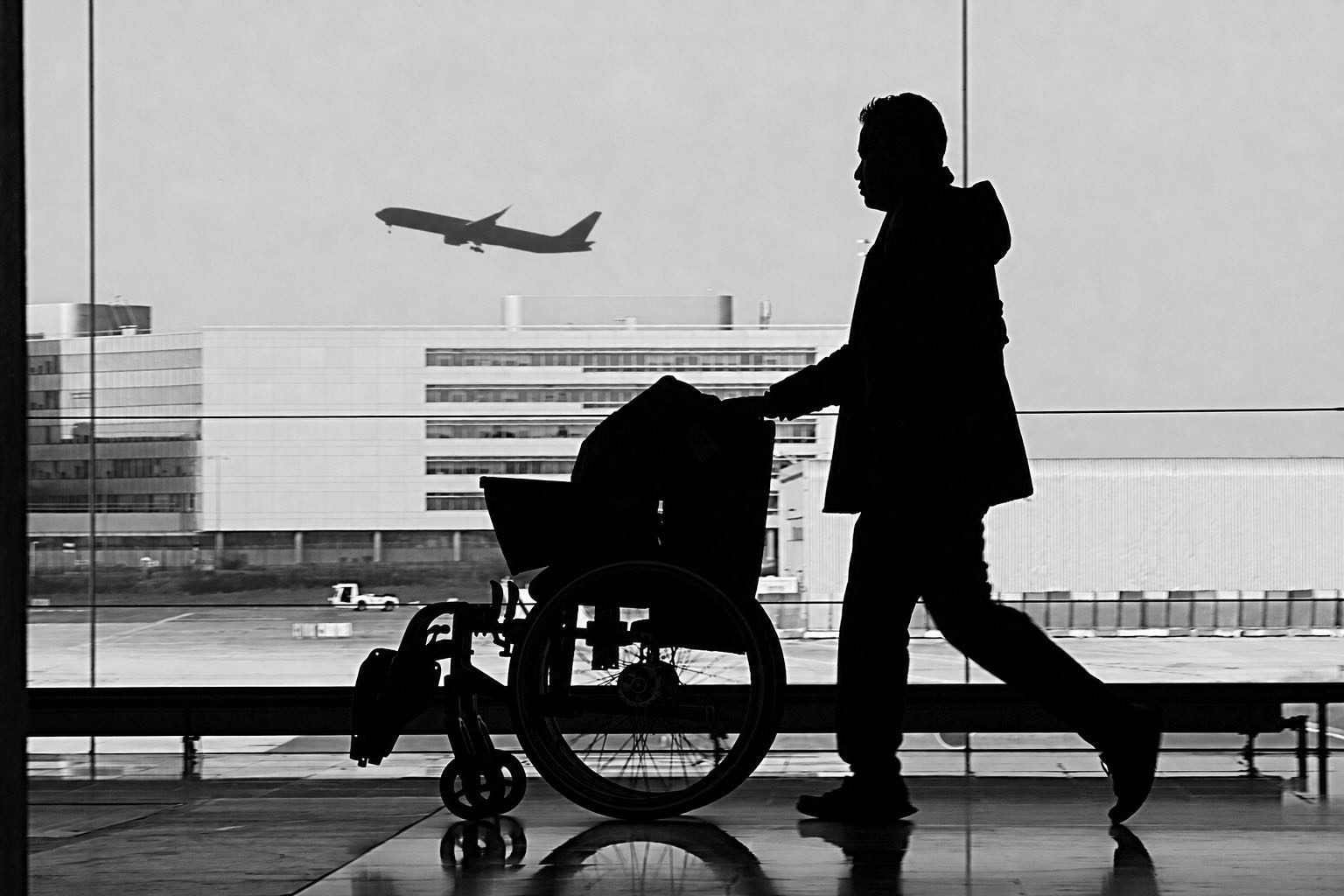
JetBlue CEO Joanna Geraghty has called out a real problem in air travel: passengers who request wheelchair assistance to skip lines and board early. The problem is obvious. The solution is not.
JetBlue CEO Calls Out Wheelchair Abuse At Airports, But Is There A Fix?
JetBlue CEO Joanna Geraghty recently addressed the difficult issue of wheelchair abuse, a topic we have visited from time-to-time that strikes me as almost as egregious as the fake service dog problem.
During an appearance at WBUR’s Breakfast Club, Geraghty said airlines are required to provide wheelchair assistance when passengers request it, but that some passengers exploit the system to move to the front of the line.
As flagged by Business Insider, Geraghty said:
“We have certain flights that have 23 to 25 customers with wheelchairs, and, frankly, nobody wants to try to address some of those challenges because it’s a very tough situation to navigate, both politically, but also just heart.”
She also acknowledged the problem more directly:
“There is a group of folks that use wheelchairs to get to the front of the line, and not for legitimate reasons.”
Most of us who travel regularly have seen the so-called “miracle flights,” where passengers who “require” wheelchair assistance to board, suddenly walk off the aircraft at the destination without assistance. #JetwayJesus
The Problem Is Real, But Policing It Is Dangerous
The difficulty is that airlines cannot simply start interrogating passengers about their disability. Nor should they…
There are passengers with heart conditions, neurological issues, chronic pain, severe fatigue, anxiety, temporary injuries, vision problems, cognitive issues, and many other conditions that may not be obvious. A person may be able to walk off an aircraft but still need assistance navigating a huge airport, clearing security, or reaching a connecting gate. It’s simplistic to reduce the use of these chairs to those who cannot walk.
So while wheelchair abuse is real, the risk of over-policing it is also real. Geraghty seems to understand that tension. She also made a broader point about the airline industry’s shortcomings when it comes to passengers with disabilities:
“In general, I don’t think the airline industry does a great job with our customers with disabilities.”
Airlines routinely damage wheelchairs and can make disabled travelers feel like burdens rather than customers. So the answer probably should not be to make disabled passengers jump through hoops to prove they deserve help, as unsatisfying as that is.
Is There A Viable Solution?
I am not sure there is a perfect solution.
One idea people often suggest is simple: if you board with wheelchair assistance, you should also deplane with wheelchair assistance. That would remove some incentive to abuse the system because you would not get to board first and then sprint off the aircraft at the destination.
But even that is imperfect. Some people may need help at the departure airport but not the arrival airport. Some may be exhausted at one end of the trip and fine at the other. Some may have short connections or different airport layouts. A rigid rule might punish legitimate travelers.
Another idea is better pre-planning. Geraghty said:
“If we could isolate out the folks who truly needed help, I think we could do a far, far, far better job with it.”
That makes sense in theory and that is primarily achieved by encouraging passengers to request assistance in advance. Under U.S. law, the airline still has to accommodate last-minute needs. A passenger can be injured, ill, elderly, or overwhelmed without planning weeks ahead.
Maybe the most realistic solution is not trying to “catch” every abuser, but reducing the incentive to abuse the system. Assigned seating helped Southwest by removing one obvious benefit of preboarding. So could silky making clear that wheelchair assistance is not a fast-track service but an accessibility service, and that abuse delays help for people who genuinely need it (though I think the people who “cheat” are probably not concerned about others).
Maybe put wheelchair passengers in the rear rows (with the added advantage that they are close to lavatories and an emergency exit)?
CONCLUSION
Joanna Geraghty is right to call out wheelchair abuse. It happens, it is unfair, and it drains resources from passengers who actually need assistance.
But since not every disability is visible, any crackdown must be handled very carefully. Passengers should not be humiliated or interrogated because they ask for help.
As long as wheelchair assistance can be used as a shortcut through security, boarding, and airport lines, some passengers will abuse it. And the people who suffer most will be the disabled travelers the system was designed to protect. No, I don’t see a way to stop it.






I recon that any community can utilize the wheelchair service but one community stands out every time – South Asians (Indians). What’s up with that?
If someone is going to be pushed around in a wheelchair just to board early, then I think there really is an unaddressed handicap there
I’m an MD. Most often I have to provide letters to schools to accommodate any child’s disability. The school will NOT make such accommodations (such as elevator access) without the letter. I don’t see how it’s wrong for an airline to require proof for anyone with a non obvious disability. The elderly, pregnancy or those with a cast on their leg would get wheelchair accommodations without proof. But if it’s something not visible, a simple doctors letter would be fine. The doctors letter would be HIPPA compliant and does not need to reveal anything about the medical condition. Simply state “My patient may use a wheelchair at the airport” signed by Dr. . That’s it. no invasion of privacy
Nothing can be done because certain people are going to be unethical. From hiring illegals for cash, to fake Weed doctors selling medical cards, to tax cheats, to married NFL coaches getting BJ’s from pregnant reports the world is filled with cheaters.
This is just another example of. Good discussion but nothing will change and we will all survive.
What about a temporary deposit of $20 outbound, and to get the deposit refunded, you have to sit and ride in the wheelchair out of the secure zone at the destination, or the airline keeps the $20. Or does that run afoul of regs?
My parents are avid cruise line travellers. My mom told a story that while on an Alaska cruise, so many people “needed assistance” that by the third port, Holland America changed the procedure from high chairs assistance first to last. She said an amazing number of people no longer needed assistance.
The obvious solution is to stop boarding them early. Someone with a genuine mobility impairment will be happy to wait. Someone hoping to skip the line will decide that perhaps they can walk after all. The point is they need to have clear access to the aisle to get the wheelchair in and out. This can happen either at the very beginning or at the very end.
That’s a BRILLIANT idea !
In theory is an idea, but then boarding a customer in a wheelchair need of assistance with the flight fully boarded it’s uncomfortable for everybody, for the customer with the need of assistance, for the customers on board, for the team assisting the customer and lets not forget this may take a while putting the flight at the risk of a delay, delays that nobody wants. The DOT has the power and the means to come up with a solution and the responsibility to make it so that the real people in need of assistance don’t end up with the short end of the stick.
Preregistration seems like a a good place to start sorting out passengers with needs. Not all the scammers will be interested in taking additional steps for an advantage and those with genuine disabilities will be best served planning well in advance whenever possible.
Simple. Wheelchair assistance would be a paid service. Want lounge access? Pay or get the right credit card. Want to check a bag? Pay for it or have elite status. Want a wheelchair, pay for the attendant’s wages.
Look, short women pay for high heels, they don’t demand it free citing disability. Dumb drivers pay for GPS, they don’t demand free navigation in their cars. People with bad eyesight pay for glasses, not free, unless Medicaid. Tall people pay for premium economy for legroom.
$500 fine if you don’t deboard with the wheelchair.
Agreed. Or forfeiture of all frequent flyer miles. Or an 10 year ban from the airline. Until there’s a compelling penalty then people will abuse the system.
The best way to combat it is to have people register with the airline that they need a wheelchair. As a part of checking in, there should be a button about having wheelchair access. It’s not an 100% fix but could deter some people. Because the airline would know if they need one pre and post departure.
I’d be happy with 1 additional passenger per wheelchair passenger at boarding. I recently had DCA IAH where a total of 16 passengers boarded with 1 wheelchair passenger…clearly a multigeneration family, but still…
Totally agree. Allow one passenger if absolutely needed especially for an elderly person, but the whole family does not need to board early.
“But since every disability is visible, any crackdown must be handled very carefully.” Your statement needs to be corrected to say “is NOT visible.”
I would start with the need to display a handicap vehicle placard or a doctor’s letter, or else an obvious visible disability.
There ABSOLUTELY is an answer to this. And anyone who questions “What can be done” and throws their hands in the air is a fool.
1. Wheelchairs board last. Full stop.
2. If you need a wheelchair to board you MUST use a wheelchair to deplane. Also last.
3. Those who do NOT use a wheelchair to deplane are added to an “offenders” list and the next time a wheelchair is requested, they are reminded of their failure to use one to deplane. Two offenses before they are no longer allowed a wheelchair or they must provide a doctor note. And if they offend again, they are simply added to a no fly list.
4. Repeat offenders are shared between airlines.
This is not rocket science. None of the above treads on ADA rights or discriminates. These rules simply require adherence to a process. Why are so many nitwits baffled by this issue?!
First, ADA doesn’t apply to air travel. Second, do you find people avoid you? I know some folks that think they have an answer to everything. They think anyone not agreeing is an idiot. And, their answers are always faulty. I avoid them.
Well unfortunately some of us have disabilities for example I have Rheumatoid Arthritis, along with other overlapping autoimmune disorders. Sometimes it is difficult for me to walk long distances and I look like a healthy person. I use it only when I know there is a long walking distance. Otherwise, I still pay to be seated in the front of the plane either way. And yes lots of people do abuse it because I have seen it. It is disheartening. And I have my handicap decal also. As I said before I use the service if I have too.
I never got the “board last” argument. Do you and your spouse want to be in 14B and C when the wheelchair pax in 14A is boarded? Plus, I’d predict with great certainty that total boarding time would grow, and not by a small amount. Also, making them pay won’t fly (and would most certainly either already be illegal or would soon become illegal).
I tend to agree – sounds good, but not very practical when implemented.
But how often will that happen to YOU? Maybe once in 10 years? I’m sure most people would be fine with it as all you need to do is to unbuckle and stand up. Plus the amount of wheelchair assistance would drop by 80% (my guess) so once in ten years is plausible and perfectly acceptable solution to me.
You don’t think “board last” would cause a steep rise in boarding times? I do. The time to get the chair down the aisles with pax on the plane, have pax unbuckle, etc., all would, I am convinced extend the time from first pax on to last pax seated a lot.
Wheelchair assisted passengers should board last. If I needed wheelchair assist, I would not complain and just be happy to be provided assistance and able to board the aircraft!
One of the reasons for using wheelchairs is the long distances one must walk in the airport. Maybe have more than one option for mobility assistance – wheelchair including boarding and deplaning, boarding assistance (someone with a cane or walker, autism , or other disability requiring assistance but not wheelchair), or golf cart assistance in order to navigate the terminal. this may help significantly with the issue.
Also, there are some who view preboarding as a status symbol. Not allowing mobility challenged passengers to preboard would certainly cut down on those requesting assistance due to percieved status , but would likely cause difficulty when boarding the actually handicapped passengers later on.
As others have said, why isn’t the obvious solution for wheelchair assisted passengers to board last?
The solution is you board them last. How hard is thatt?
article makes me think of my friend Mike’s song “Jet Bridge Jesus”
https://open.spotify.com/track/69Vptdrm7OEqRediOu7LPb?si=c739d0c45d6144cd