
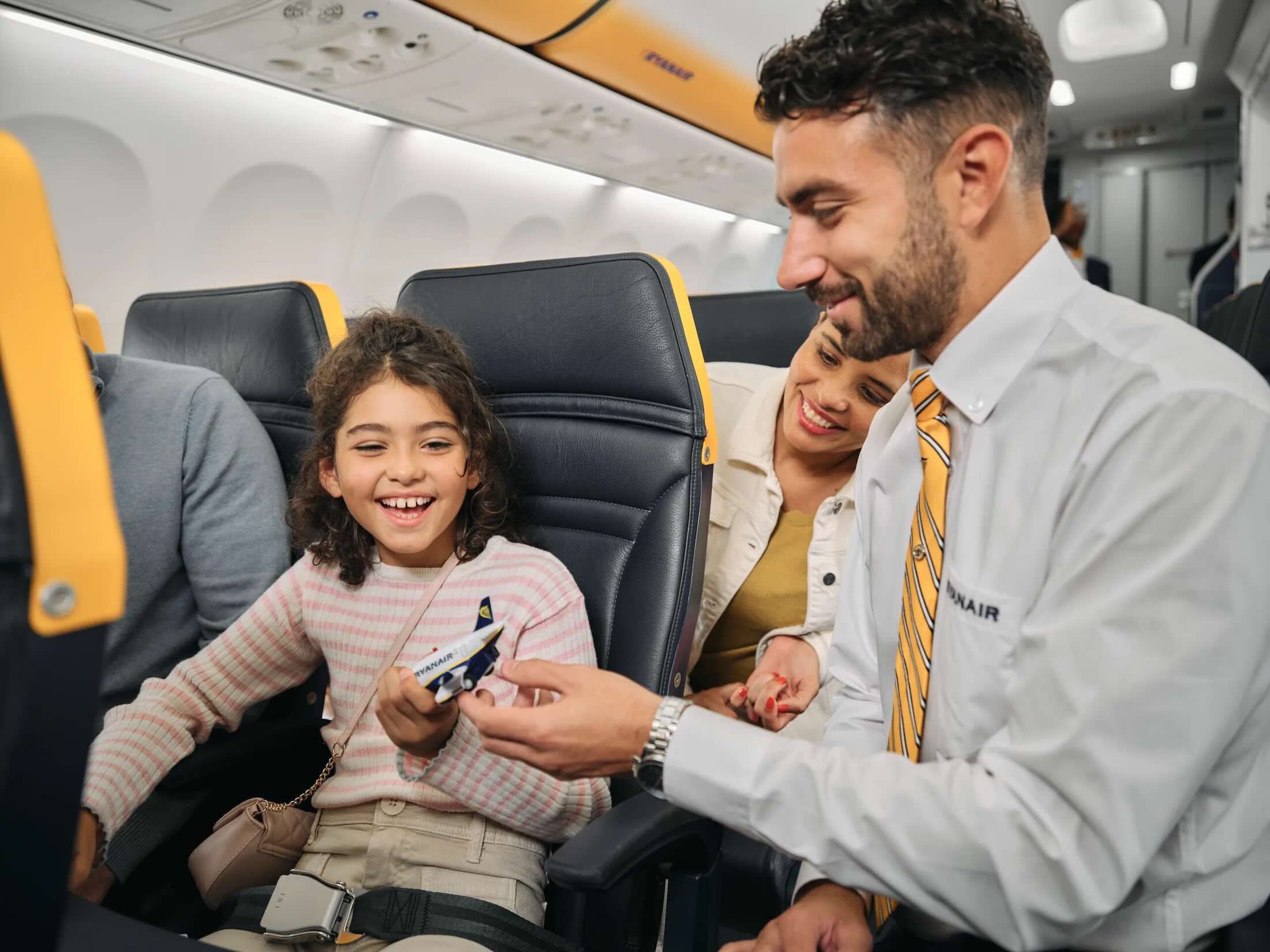
Ryanair is under investigation in the UK over its policy of making parents pay to sit next to their children, a practice the budget carrier defends as lawful and family-friendly. I have to admit that I am very sympathetic to Ryanair here.
Ryanair Faces UK Investigation Over Charging Parents To Sit With Children
Ryanair is facing a UK competition investigation over the way it charges parents to sit next to their children.
The Competition and Markets Authority is looking into whether Ryanair’s “mandatory family seat” charge may violate consumer law by forcing parents to pay for something the airline may already be required to do under aviation safety and disability rules. There is also disclosure concerns surrounding mandatory all-in pricing.
Under Ryanair’s policy, at least one parent or accompanying adult must sit next to children between the ages of two and 11. To accomplish that, the adult must purchase a reserved seat, typically costing about £8 each way. Ryanair says that once the adult purchases that reserved seat, up to four children on the same booking can be seated next to that adult for free.
That is Ryanair’s defense: it is not charging for the children’s seats, only for the adult’s seat reservation.
But the CMA is asking whether that distinction actually matters if the adult seat fee is mandatory in order to comply with family seating requirements. The regulator is also looking at whether the fee is clearly disclosed upfront or “dripped” into the booking process later.
The BBC reports that the CMA understands Ryanair is the only major airline flying from the UK that imposes this sort of charge.
Ryanair, predictably, is not amused. The airline called the investigation “bogus” and says its family seating policy fully complies with all relevant laws and regulations.
Ryanair’s Defense Is Technically Plausible, But Also Very Ryanair
Ryanair’s argument is not entirely silly. The airline is not charging a separate seat fee for each child. It requires one adult to pay for a reserved seat, then allows up to four children to sit next to that adult for free.
On one level, that is not the worst family seating policy in the world. At least it guarantees that children are not scattered around the cabin, which is better than the game of musical chairs that some airlines still play with families.
But it is also classic Ryanair.
Advertise the lowest possible fare, then charge for everything else…the business model is not a secret. Ryanair has made billions by separating transportation itself from everything adjacent. The question here is whether sitting a young child next to a parent is really an optional extra, like choosing row 4 instead of row 22, or whether it is part of the basic product when a family books air travel, like a seatbelt.
Critics of Ryanair understandably argue that a parent sitting next to a five-year-old is not optional like extra legroom or a window seat with a view. It is basic common sense…
Should Airlines Charge Families To Sit Together?
Of all the ancillary fee issues, the issue of family seating is one that I struggle with the most.
I have no issue with airlines charging for seat assignments in general, especially on ultra-low-cost carriers. If you want to choose a specific seat, pay for it. If you do not care, take what you are assigned.
But families with young children are different.
We can all agree that a four-year-old should not be sitting alone next to strangers while a parent is six rows away. That is bad for the child, bad for the parent, bad for the strangers, and bad for the crew who will inevitably have to sort it out onboard.
From a safety perspective, it also makes sense for a parent to be seated next to a young child. In an emergency, who is going to help the child? The random passenger next to him? A flight attendant during an evacuation? Of course not. The parent should be there.
But I do understand Ryanair’s point. Ryanair will say that families still save money overall because its fares are so low. Even with the seat fee, Ryanair may still be significantly cheaper than British Airways or even easyJet. It seems to me that if families wish to book on Ryanair, they should expect to all pay for seating as part of the bargain because it is irresponsible parenting to even consider leaving your children separated from you.
I don’t think regulators are necessarily wrong to question whether Ryanair is charging for something that public policymakers have placed on the same level as safety, but I also don’t think that Ryanair should be compelled to undercut its business model for a seating issue: if parents want seating to be included with their ticket price, they can book with British Airways or another full-service carrier.
You see the tension?
In any case, if a charge is mandatory, it should be disclosed clearly and upfront.
CONCLUSION
Ryanair is under investigation in the UK over its policy requiring parents to pay for a reserved adult seat in order to sit next to children aged two to 11. Ryanair says its policy is lawful, saves families money, and allows up to four children to sit next to the adult for free once that adult seat is purchased.
While we can all agree that when young children are involved, sitting next to a parent should not be treated like an optional upgrade, how to handle this is a matter of debate in which reasonable minds can disagree.
Families should not be nickel-and-dimed for something that is both common sense and arguably part of basic onboard safety, but families should also not expect a budget carrier which depends on ancillary fees to stay afloat to subsidize its decision to fly on the carrier.
So what’s the answer? I’m still thinking about it…
image: Ryanair






The cost for one of these FR family seats is typically $5-$15 per flight. for that you get up to 5 seats (1 Adult+4kids).
By any account, this is a pretty modest charge. I feel there are other fees more deserving of investigation.
I think this is actually a pretty generous policy, and I don’t think Ryanair would be wrong to require seat payment for all passengers with children at booking (11 is a good cutoff). Seat assignments are an integral part of their business model, and it isn’t only young children who might require being seated next to a companion. The best comparison I can think of is a car seat. A taxi driver is under no obligation to provide you with one, though there are services that do and nobody objects to paying for that.
Agreed. Where I have a little more trouble is a basic economy fare on a full-service carrier, but I guess the same logic applies?
A legacy carrier offering it on a basic economy fare seems like a great point of differentiation. Ryanair doesn’t exist without reserved seat fees, but BA certainly does.
Somehow this seems more reasonable than which seats children can sit in when flying Allegris seating?
I don’t understand the investigation – it either violates the policy in the eyes of the UK regulator or it does not, right? They can take a position one way or the other. Does the UK regulator think that this “investigation” gives them a chip in some other negotiation going on with Ryanair?
You americans fail to understand EU/UK customer protection regulations.
The problem is not how big or small seems to you the charge for the seat of the parent, nor whether how “fair” or ethical is to have such a policy.
The issue is, in EU/UK airlines cannot advertise a lower price for a ticket that does not include ABSOLUTELY ALL mandatory charges, fees, surcharges or whatever invention the airline can come-up with.
So, just being a parent traveling with your kids does not justify an additional mandatory surcharge. Full stop.
This is what Ryanair tries to bypass, and it is absolutely right to investigate whether this is a breach of fare regulations.
And yes, I hope Ryanair is hit by the regulators.
I like your style, Alex. Thank you. (Additionally, I wish we had an EU/UK 261 in the US.)
Thanks for try to educate us stupid Americans. But, your effirt is worthless; we are just too stupid.
But on the one hand you are saying it violates the policy full stop, and on the other you are saying there’s a need for an investigation. If it is so cut and dry that they are violating the law, the regulator should just take action, right? What’s the point of an investigation?
Or maybe it does…that’s a separate issue from mandatory disclosure.