
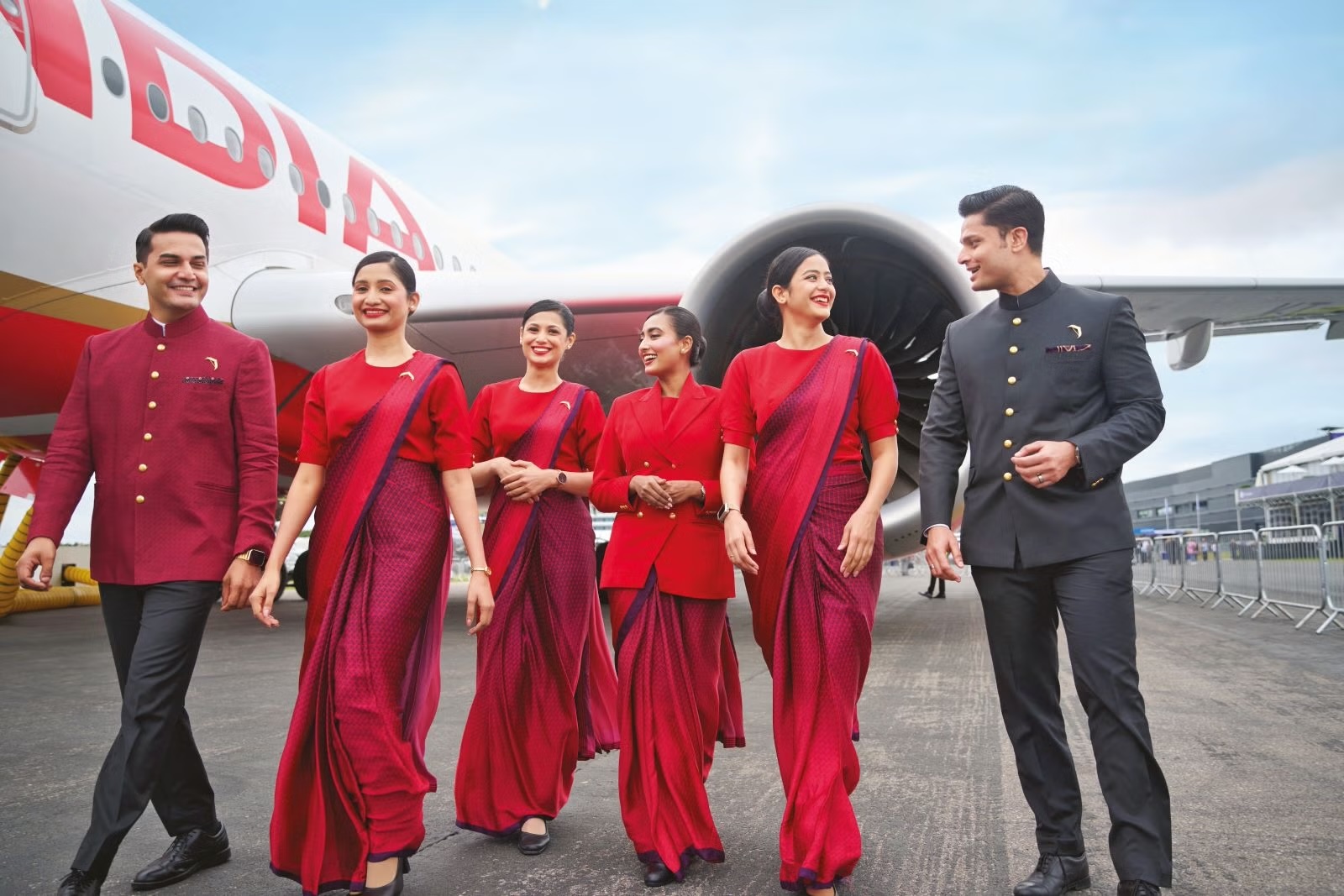
Air India’s grand turnaround is running into a familiar airline reality: growth is easy to announce, but losses are harder to absorb.
Air India Hits The Brakes As Tata Group Pushes Cost Cutting Amid Mounting Losses
Air India is reportedly shifting from growth mode to cost-cutting mode as losses mount and owner Tata Group grows less willing to bankroll the airline’s ambitious turnaround at any cost.
OMAAT flags a Bloomberg report that Tata Group has instructed Air India management to focus on reducing losses rather than simply growing. That reportedly means deferring aircraft deliveries, scaling back both domestic and international expansion, stabilizing operations, and cutting costs.
Air India is said to be in talks with Airbus and Boeing to slow delivery of hundreds of jets. That is quite a shift from the post-privatization narrative, when Air India’s transformation was framed around growth, new aircraft, new cabins, new lounges, and a chance to claw back Indian longhaul traffic that has been flowing over Doha, Dubai, Abu Dhabi, Istanbul, Singapore, and Europe for years.
The problem, while not wholly unexpected, is that the transformation has been expensive and slow.
Air India was privatized in 2022, returning to Tata Group, which had originally founded the airline decades earlier. Since then, the carrier has placed one of the largest aircraft orders in aviation history, merged with Vistara, begun introducing new aircraft and cabins, and promised a dramatically better passenger experience.
But the old Air India did not become the new Air India overnight. Many longhaul passengers are still flying on old aircraft with tired interiors, uneven service, and a brand reputation that remains difficult to overcome.
Meanwhile, the carrier reportedly posted a record loss of roughly $2.8 billion in the most recent financial year…the sort of number that causes even a conglomerate like Tata to ask how long this turnaround will take and how much more it will cost.
Air India’s Turnaround Was Always Going To Be Painful, But The Timing Is Bad
Air India was not a normal airline turnaround. This was an airline that had spent years under government ownership, with all the dysfunction, bureaucracy, and customer-service inconsistency that came with it. Fixing that was always going to take years.
You cannot simply repaint airplanes, order new jets, unveil a new business class seat, and assume premium passengers will suddenly abandon Emirates, Qatar Airways, Etihad, Turkish Airlines, Lufthansa, Air France, and Singapore Airlines.
We see that product transformation takes time. But to its credit, Air India has made real progress. Its A350 product looks far better and the new branding is sharp (teaser: I’ll soon give it a try myself!).
But Air India still has a long way to go and high fuel prices make this turnaround even harder.
Air India’s longhaul strategy depends, at least in part, on recapturing India-bound traffic that has historically flowed over the Middle East. In theory, that makes sense. India is a huge market, the diaspora is massive, and nonstop service should be attractive.
But the Middle East carriers are not simply going to surrender that traffic. If Emirates, Qatar Airways, and Etihad discount aggressively to protect market share, Air India has to compete with lower fares while also carrying high fuel costs, paying for a fleet renewal, dealing with aircraft delivery delays, improving its product, training staff, integrating Vistara, and fixing years of operational baggage.
That is a very hard equation and the current geopolitical environment is not helping.
A difficult journey has become much harder.
Cost Cutting Must Not Mean Product Cutting
If Air India cannot absorb hundreds of new aircraft as quickly as planned, then deferring deliveries makes sense. A disciplined turnaround is better than reckless expansion. But the risk is that “cost cutting” becomes an excuse to cut the very things that Air India needs most.
Air India cannot cost-cut its way to greatness by reducing cabin investment, delaying retrofits indefinitely, trimming soft product, understaffing stations, or letting the passenger experience remain inconsistent. That would be penny wise and pound foolish. The whole point of the Tata takeover was to make Air India credible again. That requires investment…and a lot more of it when fuel prices double.
If Air India slows growth but continues investing in hard product, reliability, lounges, training, and service consistency, this could be a sensible reset. If Air India slows growth and also starts hollowing out the passenger experience, then this turnaround becomes meaningless.
Tata is right to care about losses. But Air India cannot become competitive by being merely less bad than before. It has to become consistently good…
A Need For A Strong CEO
Air India is also preparing for leadership change, with CEO Campbell Wilson stepping down in 2026. Air India has said that Wilson informed Tata leadership back in 2024 of his intention to leave, so this was apparently not a sudden departure. Even so, leadership transitions during major turnarounds are never simple.
Wilson inherited an extremely difficult assignment so I don’t fully lay the blame at his feet: the airline had too many legacy issues, too much reputational damage, and too much operational complexity.
But his successor will now have to manage a carrier that has huge ambitions, huge losses, a massive aircraft order book, Vistara integration, international competition, and a more impatient owner.
May I suggest Ben Schlappig for the job? 😉
(I’m quite serious…)
CONCLUSION
Air India is reportedly shifting from aggressive growth to cost control as Tata Group grows increasingly concerned about mounting losses. The airline may defer aircraft deliveries, scale back expansion, and focus on stabilizing operations.
That is probably sensible, but only if cost cutting does not come at the expense of the passenger experience. Air India still needs better everything (cabins, consistency, ground handling, reliability) and a stronger premium proposition if it wants to win back longhaul traffic from the Gulf, European, Asian, and U.S. carriers.
Air India’s turnaround was always going to be expensive and messy. Does Tata have the patience to finish what is started? I sure hope so or else these billions of dollars were all for naught.
image: Air India






If Ben becomes the CEO of Air India I may actually start flying them!
I mean, I thoroughly enjoy Matt and Ben’s commentary and reviews, but… run an airline? That’d be like electing a reality television ‘star’ as our President… twice.
Ben is a very smart man and as far as I see it, why not? Air India has been a basket case for years, even now under Tata, and it’s time to bring in a true outsider who understands the industry very well….then again, he’d have to have an “Aaron” (in the sense of Aaron speaking on behalf of Moses) since he’s such an introvert! 😉
Fantastic reference! (This is why I love your blog!) Yes, for those “slow of speech and tongue” an “Aaron” is most helpful. Matthew, would you be open to the role of Chief Communications Officer at this revised Air India corporation?
Didn’t they make an expensive ( and beautiful ) video showcasing India without any branding?
Lucky would be a great choice. I second the motion.
Not all airlines are meant to be profitable businesses. There are other perfectly valid policy reasons for maintaining an airline. If the cost of a growing and modernizing Air India that represents the country well in all major international markets is a $2.5B in annual loss, that the Indian Government would be wise to see that as a small price to pay and subsidize Tata’s operation of the airline.
Oof… a round of cost-cutting now will only delay the improvements that this company so desperately needs. Tata made a net profit of around $13.5B in 2025, so it’s not like a $2.8B loss will require any family members to tighten their belts. Get the job done.
Agreed – it’s the only way for AI to rebound.
I love a good ole “Oof” — thank you!
I’d rather fly Aeroflot, Air Koryo or PIA than Air India – before even upgrading their planes and cabin they need to educate their employees in customer service – non-existent!!