
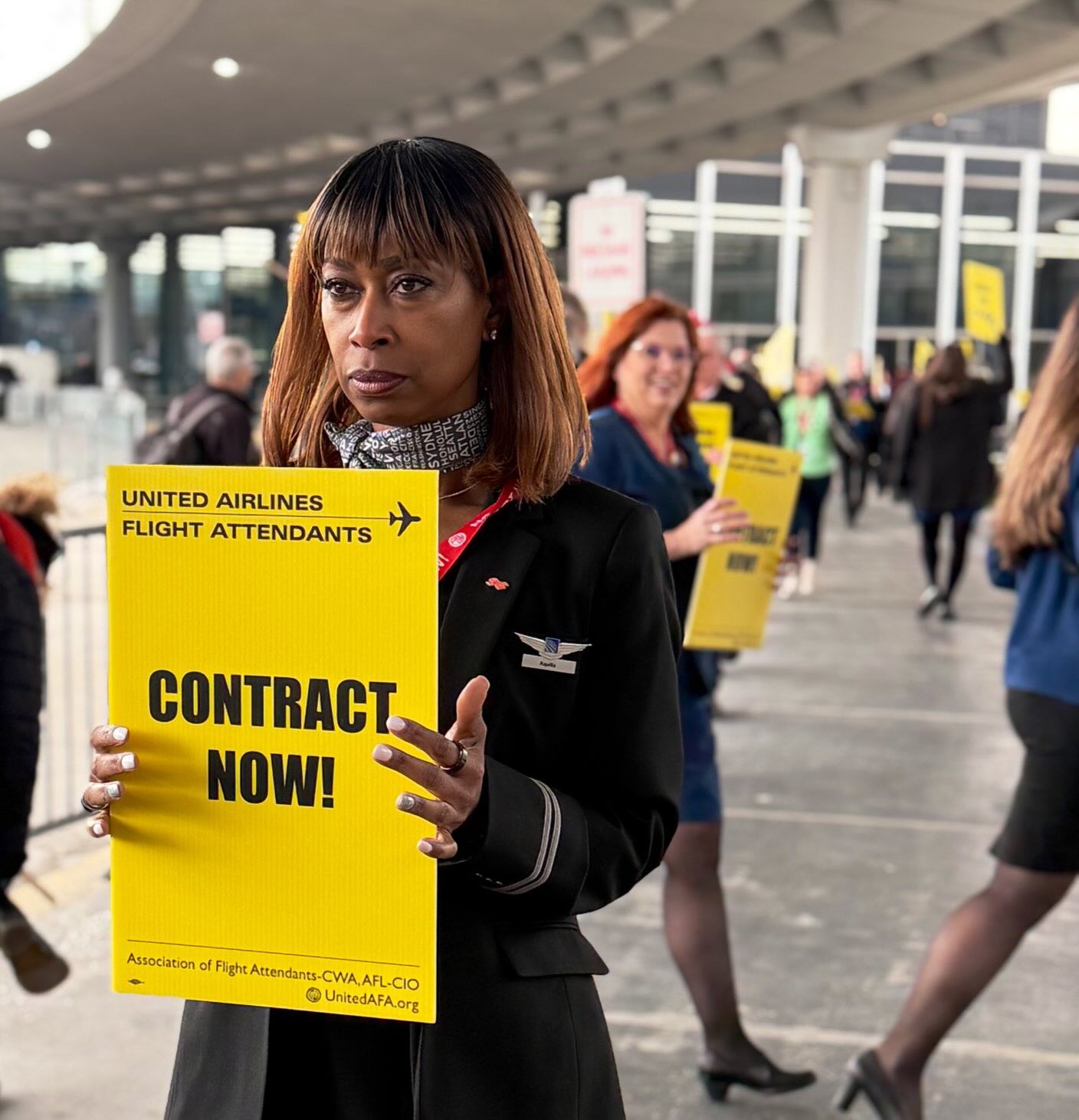
After years of stalled negotiations and a decisive rejection of a tentative agreement, United Airlines flight attendants are once again sitting down with management. But this time, the tone is sharper, expectations are higher, and patience is wearing thin (not that such sentiment makes a deal any more imminent).
United Flight Attendants Return To Contract Talks As Tensions With Management Escalate
United Airlines flight attendants, represented by the Association of Flight Attendants (AFA-CWA), have resumed contract negotiations this week under federal mediation in Chicago. The talks come after a long and increasingly contentious bargaining process that has dragged on since the previous contract became amendable in August 2021, leaving many United flight attendants without a raise for years.
This latest round follows the overwhelming rejection of a tentative agreement last year, when roughly 71% of voting flight attendants said no to a proposed deal that included significant pay increases, signing bonuses, and higher per diem rates. While United characterized that agreement as industry-leading, many flight attendants argued it failed to adequately address core quality-of-life concerns, including scheduling flexibility, rest provisions, and reserve utilization.
The rejected agreement would have delivered immediate wage increases averaging nearly 27%, along with retroactive compensation. However, flight attendants expressed frustration that economic gains were paired with what they viewed as concessions on work rules and long-term protections that if ceded, could never be clawed back. For many, the issue went beyond pay pay, focusing on the cumulative toll of years of what they describe as an erosion of working conditions.
Since that vote, the union has shifted its messaging. Rather than framing talks around tradeoffs, AFA leadership is now pushing for immediate economic relief without concessions, reflecting both inflationary pressure and growing fatigue with the pace of negotiations.
Union Draws A Harder Line
As talks resumed, union leaders made clear that proposals involving givebacks or dilution of existing protections are off the table. The union is seeking immediate wage increases, enforceable staffing and rest standards, and contractual language that better reflects the realities of post-pandemic flying, including:
- Pay for waiting on the ground between flights
- Less tiring red-eye flying
- No more layover notifications
- More rest on longer flights
- Contract compliance guarantees
- Improvements for reserve flight attendants
- Better layover hotels
- Improvements to health care and retirement benefits
This stance puts United in a difficult position. Management has emphasized the need to balance competitive compensation with cost savings, while also repeatedly signaling a desire to reach an agreement and avoid further labor unrest. Executives previously suggested a deal could be finalized in early 2026, but I’m told the gap between the parties remains significant.
United’s flight attendants are among the largest and most visible workgroups at the airline, and prolonged labor tension carries both operational and reputational risks. While there is no immediate threat of job action, the intensity of the union’s rhetoric and the size of the rejected vote underscore how motivated flight attendants are to secure a contract they view as genuinely fair.
Even so, I have to give flight attendants credit for not “taking it out” on their passengers. I’m not quite as frequent a United flyer as I used to be, but I’ve had (almost) nothing but good service over the last year on United, which is commendable when costs have risen so significantly and wage have not.
> Read More: United Airlines Flight Attendants Outline New Demands After Rejecting Contract
CONCLUSION
The resumption of contract talks marks an important moment for United Airlines and its flight attendants, but an agreement still seems far off. With trust strained and expectations elevated, these negotiations will test whether both sides can bridge the gap…and I’m not optimistic. For now, the message from flight attendants is clear: a deal is possible, but only if it meaningfully improves both pay and day-to-day working conditions. But if United managements views that as having your cake and eating it too, I’m not pinning hope on much progress this week.
image: @AFAUnitedMEC / X



Well, I hope they prevail, and get what they’re asking for, soon.
Since they will get back pay, they really have very little ultimately to worry about it and no incentive to quickly sign a contract. FAs who have been with the company since 2021 will get a huge check once the deal is done.
Well, in that case, take as much time as they need, no false urgency here; get it done right!
Can they give their landlords and supermarkets back pay when they get it? I’m sure they feel no urgency
Andy, they aren’t currently working for free…
You’re actually wrong. Yes they get back pay but it’s only a small percentage of the lost wages they would get if the contract would be ratified when it became amenable. So the more they wait, the less they get and the more inflation will eat the margin.
It’s not necessarily a small percentage. AA FAs, for example, got a gradual increase for 2020-2024, including almost 21% backpay for 2024.
Matt – back pay in the airline industry is never 100% of the pay you would have received, had the new contract been in effect when the old contract became amendable. In fact, even with the large contracts that Delta’s and United’s pilots received during the last round of negotiations, their contracts – which included back pay – was not “full” back pay either (“retro pay” per the unofficial union jargon, and a “signing bonus” as officially inscribed for accounting purposes).
This is typical of railway labor law contract cycles. The longer it takes to ratify a new contract, the longer the employees are losing out on the higher money (and delay tactics are typically seen by the company for this very reason).
Yes – United’s flight attendants will get a nice “signing bonus” pay check once a new contract is ratified. But it will only be a percentage of what they would have received in a pay raise, had the new rates been in effect back in 2021. So they absolutely DO have something to worry about, and have a big incentive to quickly sign a new contract.
So, back to the false sense of urgency, eh? Seems beneficial to management, not the workers, but ok…
1990, it’s not a “false” sense of urgency at all – my point is that Matt was not correct. He said, “they really have very little ultimately to worry about it and no incentive to quickly sign a contract.”
United’s flight attendants absolutely have an incentive. Any further delay in getting a new contract (and getting new pay rates) means lost money. Any “retro pay” (“signing bonus”) is never equal to the amount they would have made if the contract was ratified earlier. Delays = losing money.
Ever wonder why airlines pretty much NEVER get to a tentative agreement on a new contract “on time” (when the old one becomes amendable)? It always saves the company money to stretch out how long the old one remains in effect (along with the old pay rates) despite any fractional “retro pay” they have to pay out when the new contract is finally signed.
It would be like you have to negotiate with your bank to refinance your mortgage to a lower rate – think the bank would be incentivized to do it quickly?
So, what do you think they can honestly do at this point to make this work, other than officially or unofficially strike?
Great question – what to do? Having mediation as part of the process (which they do) helps to keep the process towards a new contract moving, and if the mediator sees the company is stonewalling, they can declare an impasse. Having a mediator say there’s no way to bring the sides together does give more credence to allowing “self help” i.e. a legal strike by the flight attendants (after the cool down period, etc).
But under the rules, it always goes really badly for a union to have any type of coordinated “work action” to try to speed things up. No sickouts, no slowdowns, etc. A judge would smack that down in a heartbeat, and multi-million dollar fines against the union would result. It has happened before with other airline unions covered by the Railway Labor Act.
Informational picketing is allowed, and does help generate publicity and sympathy with the public – and companies, especially airlines, hate negative publicity. United’s flight attendants are doing one in about a week in Chicago at United’s headquarters.
But other than continue to negotiate in good faith, there is very little that a union can do to move things along. Eventually, it comes out that a company is slow rolling the process, and mediation/arbitration will work in the union’s favor. But until then…?
Also, I’m not sure that back pay takes into account the cost of capital. They could have been investing the pay they have missed for the last several years.
I’m not in favor of back pay as a bargaining tool. Yeah, it may be 80 cents on the dollar considering how well the stock market is done, but it’s still “free money” in the sense that I don’t think any FAs would walk if a deal included immediate higher wages but no back pay.
The RLA incentivizes companies to drag out the process which means that companies, at best, are borrowing money from their unionized employees which they might or might not have to repay.
In the case of the AFA, they made the stated decision to wait until AA settled with its FAs so that UA couldn’t settle for less than what AA FAs got – and the result was that the amount of borrowing that UA was able to do has ballooned now that UA FAs are the last of the big 4 to get anything.
Trying to be last was an absolute bone-headed call in the midst of some of the highest inflation the US has seen in 40 years; even full retro based on whatever the FAs negotiate will mean the FAs actually get much less – Matthew’s 80% estimate is generous in this kind of environment.
and if you want to look how UA spent the FAs’ money, you need only look at its massive aircraft purchases which are only going to get bigger as Airbus and, most Boeing, get deliveries to contractual levels.
UA as a business is not going to look as good with higher labor costs which will reduce cash generation and higher labor costs – on top of the increased and strong competition among the other big 4 carriers.
Yeah, and if they REALLY lose patience, Trump will let them strike and let the economy take a big hit.
HAHAHAHA……
…I knew I couldn’t say that with a straight face…
Usually, most strikes aren’t ‘allowed’… but, I get it, better to have unions and cooling off periods and NLRB than the alternative, which used to be pitchforks and showing up at the owner’s mansion. Do we need to recall our history?
It’s the National Mediation Board (NMB) for the Railway Labor Act (RLA) not the NLRB.
The NMB release and 30-day cooling off periods are fairly restrictive. Would be ‘nice’ if NLRB would assert jurisdiction as it did for the ground workers in that Swissport case (2024). Would make it far easier to organize and to strike for AFA-CWA and the flight attendants. Either way, hope their T2 push in 2026 leads to a better result.
Time to STRIKE!!
first, UA took a charge for retro payment for an FA contract during the contract votes in the 2nd quarter of 2025 so they legitimately expected they would have to pay retro. That amount likely will still grow as contract negotiations continue. UA could amend that charge which was just for accounting – the money didn’t actually get to FA pockets.
and UA has not indicated how much FA total compensation will go up; all of the talk from FAs about how much pay will go up as to be offset by workrule changes which are simply not known at this time.
the assumption that the current administration will not allow labor to legitimately threaten a strike is misplaced. UA is in the unique position of being the only airline with multiple major labor groups w/o contracts; the impact to the US economy is simply not as high as if other airlines also have open labor contracts. In fact, mediators are far more likely to allow UA FAs to push harder since it is apparent they really are worse off than FAs at AA, DL and WN.
Would UA FA’s calling out sick (unofficial strike) help Delta? Asking for a friend.
I will leave you to figure that question out for yourself but it is rather amazing that UA’s FAs have been as patient as they have during labor negotiations.
DL FAs are now into their 3rd or 4th pay raise post covid, WN FAs worked pretty quickly to get a new contract w/ little impact to customers while AA FAs put on a pretty high profile campaign that certainly put pressure on mgmt to get it sorted out.
The first two examples can’t apply to UA FAs at this point which makes you think they better come up w/ something that is more effective in pressuring mgmt than what they have done for the past five years all while UA is financially better off than AA or WN and trying to act like it is comparable to DL in financial performance – which they aren’t even w/ the labor cost advantage they “enjoy”.
Would more red lanyards help the cause?
IMO, the AFA is in a losing battle. The time has passed for “industry leading” contracts like last year. UA is not going to offer anything substantially different that what FAs at other AFA represented airlines got. Second, and more important, we are now under and Administration that is downright hostile to unions, so there’s no chance of a strike. Furthermore, it the FAs try and pull any “unorganized” strike or sick-out, it wouldn’t surprise me that UA could get a court order against them.
In the end, the AFA needs to get a contract comparable to what was agreed at other airlines, maybe get a marginal win or two on some of the other issues, and get it agreed and passedby membership.
As is known, being a flight attendant is one of the most demanding and patient professions in the transportation sector… Best of good luck to the UA flight attendants!
Working in the private sector, despite its well-known advantages, has become increasingly risky for certain professions… As our wise elders used to say: “If you are married, your spouse must work, and at least one of you has to be employed in the public sector!”
I’m just surprised that Lord Nelson and her flunkies are still in control of the union after they’re the ones who tried to sell membership on the rotten deal that recently got turned down. There’s no question that Kirby has been horrible – even for him – in these negotiations but the union needs true leadership that will stand up to Kirby rather than change plans all the time.
If a change in union leadership would get the members what they want, then the members can and should have elections; however, changing ‘generals’ mid-‘war’ might not be an effective strategy… or it could be. Who knows.
The Army Of The Potomac felt that changing leaders was problematic. If they’d been winning I’d agree. Nelson and her stooges have not done a thing to visibly improve things for their members IMO.
Being penny wise and pound foolish will pay you back in poor passenger treatment and satisfaction. Sure, I get giving the pilots a rich contract but let’s be honest, do their pilots really need a 18% 401K match plus a pension? If they provide a crappy contract I’d hate to see their customer satisfaction scores going forward. Kirby, here’s a tip. You will always be way behind Delta and you’re proving that with your determination to look at only excel sheets. SMH!