
Alaska Airlines crosses the Atlantic for the first time April 28. Meanwhile, nine days earlier, British Airways restores a UK nonstop to St. Louis, the first since 2003.
The Route Nobody’s Covering
The travel blogosphere is busy writing about Alaska Airlines’ April 28 Seattle-Rome launch. It is, fairly, a milestone as Alaska’s first-ever transatlantic route, a flagship 787-9, a genuine expansion of where the airline competes. Delta counter-announced matching Seattle–Rome and Seattle–Barcelona services before the launch even occurred. Our colleagues across the BoardingArea network alone has published a dozen variations of the story.
Nine days earlier, something perhaps as consequential happens quietly.
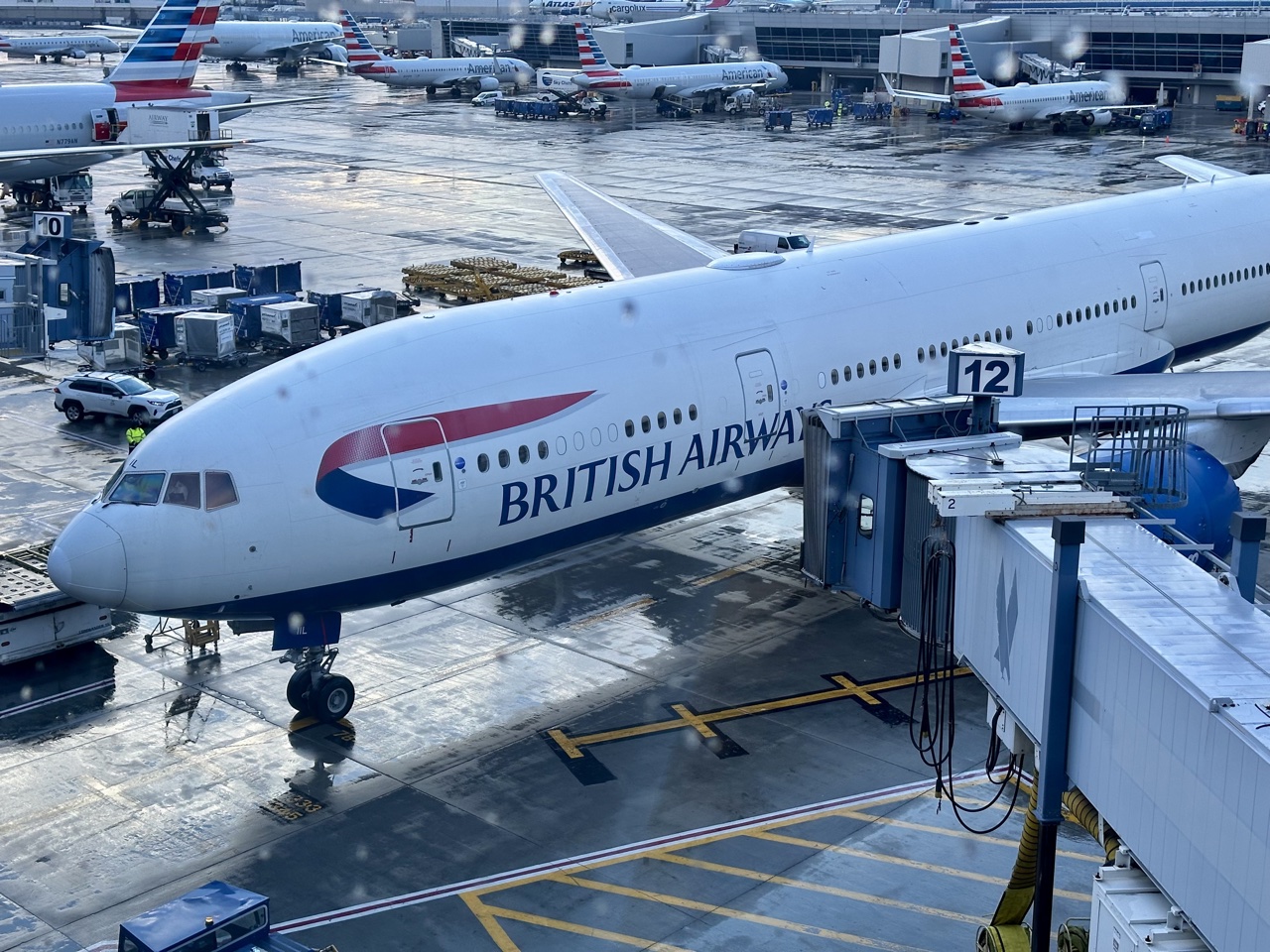
Today, April 19, British Airways launches four-times-weekly nonstop service between London Heathrow and St. Louis Lambert International Airport. BA221 departs LHR at 16:25 and arrives in STL at 19:30; BA220 departs STL at 22:00 and arrives back at Heathrow at 12:05 the following day. The aircraft is a Boeing 787-8, with all three BA cabins — World Traveller, World Traveller Plus, and Club World (business cabin.)
It is the first UK nonstop flight to St. Louis in 22 years.
The 22-Year Gap Tells The Real Story
British Caledonian began St. Louis-London service in 1980. The route passed to Trans World Airlines in the mid-1980s and became part of TWA’s small but important international footprint from its St. Louis hub. American Airlines inherited it in the 2001 TWA acquisition and kept it alive for exactly two years. AA terminated the London Gatwick route in October 2003.
That was the last UK nonstop from St. Louis.
In the 22 years since, the city’s European service has been almost nonexistent. Wow Air briefly flew to Reykjavik in 2018 before the airline collapsed. Lufthansa launched Frankfurt service in June 2022, which remains. That’s it. A mid-major American city with a metropolitan population over 2.8 million, the twenty-first-largest metro area in the United States, has had essentially no direct European service for two decades.
Why BA Sees What American Couldn’t
The easy read is that BA is opportunistic, STL (like many municipalities around the United States) offered incentives, the local business community lobbied hard, and a foreign carrier picked up what a US airline abandoned. That’s partly true. The more interesting read is that BA is executing a pattern. The city’s TWA history shows that St. Louis has a populous base that embraced international markets both for business and for personal travel.
Look at where British Airways has added or restored US service in the last three years: Portland (PDX), Pittsburgh (PIT), Nashville, and now St. Louis. These are not primary coastal hubs. These mid-market American cities that post-9/11 hub consolidation orphaned, cities that used to have widebody transatlantic service and lost it when US legacies rationalized around their biggest hubs.
BA sees that the traffic didn’t disappear. It was suppressed by the lack of nonstop product. Feed through Chicago or Dallas or Atlanta, and the one-stop friction is real, but offer a nonstop, and origin demand materializes. The oneworld AAdvantage and Avios co-brand base in middle America is larger than most US network planners assume when they model routes from their coastal command centers. In the case of Pittsburgh, the city guaranteed the route with subsidies for 4x week service but has moved it to 5x, 6x, and through the summer, daily service due to demand.
American Airlines killed the St. Louis route. Twenty-two years later, its oneworld partner picks it up. That tells you something about where AA’s planning lens points versus where BA’s aims. The British Airways St. Louis-London route adds to a constellation of more than 30 North American gateways of which 28 are in the United States.
The Points Angle
London-St Louis is redeemable via AAdvantage miles, British Airways Avios, Iberia Avios, and every other oneworld currency but adds considerable fuel surcharges.
A few things to know about the product. The 787-8 Club World is the older Club Suite / existing Club World business class, not the newer Club Suite found on BA’s 787-9s and refurbished 777s. Expect a 2-3-2 or 1-2-1 layout depending on configuration, not category-leading. World Traveller Plus (premium economy) is BA’s underrated sweet spot at this distance.
Availability at launch remains tight. Four weekly frequencies equates to 208 business class seats per week in each direction, a fraction of what daily widebody routes offer. Saver-level awards should be sought and booked the moment they open.
What The Next 24 Months Look Like
If BA’s St. Louis experiment works, and there’s reason to think it will, given the 22-year suppressed demand and the incentive structure, I expect announcements into markets like Kansas City, and Indianapolis. Aer Lingus is already executing this exact playbook with the A321XLR (Raleigh-Durham, Indianapolis, Minneapolis, Nashville, and Pittsburgh all launched this year). KLM and Air France via Delta have been quieter, but the same logic applies.
But the other part of this story has a place too. Alaska will continue to expand its map as well. It’s already announced a launch for Seattle-Iceland service on a 737 making it one of the longest routes on the type. But Alaska’s move this week is substantial because it is the very beginning of its trans-Atlantic journey. If it wants to be able to expand globally, it seems that smaller outposts on single-aisle aircraft are part of that picture. It’s significant that Alaska is commencing Rome service, but those two markets will have no trouble performing, it’s not particularly ground breaking as a city pair. St. Louis is a different statement and one that British Airways is likely to prove out.
Conclusion
Congratulations, truly, to Alaska Airlines for running an incredible airline, pulling off a massive conversion from regional power to flag carrier. Their efforts will no doubt be rewarded handsomely, and I personally want to fly the route at some point in the future. But understanding British Airways move to St. Louis is more of a glimpse into where transatlantic aviation is actually going, the mid-market American cities.
What do you think?




This is a horrendous take. St Louis is only getting British Airways because of “free money.” It’s the only reason why Pittsburgh has service. This market cannot support service, which is why it’s being done at the bare minimum. It’s why Indianapolis has also struggled to maintain European flights. Nobody in London is saying, “Let’s go to St. Louis.”
Someone in London is saying “let’s go to St Louis” because, while it’s not a tourist destination, there is still corporate interest between the two cities but the bigger issue is that, while subsidies are there, most subsidy-started BA markets in the US have maintained service except CHS.
This is far more about getting the local STL population to London and Europe than it is about demand to STL and STL passengers get to do it using/accruing miles on their preferred US3 carrier — AA.
All about the view of that Gateway Arch from East St. Louis, where there are ample Fine Illinois Brethren…
“Why BA Sees What American Couldn’t
The easy read is that BA is opportunistic, STL (like many municipalities around the United States) offered incentives, the local business community lobbied hard, and a foreign carrier picked up what a US airline abandoned. That’s partly true. The more interesting read is that BA is executing a pattern. The city’s TWA history shows that St. Louis has a populous base that embraced international markets both for business and for personal travel.
Look at where British Airways has added or restored US service in the last three years: Portland (PDX), Pittsburgh (PIT), Nashville, and now St. Louis”
Dude… BA isn’t seeing what AA couldn’t… You write this like the joint Venture doesn’t exist with AA. AA and BA generally decide jointly where to add and, of course, it’s more operationally efficient for BA to add service from a hub than AA to add a wide body to a non-hub.
BA and AA are seeing markets where AA is the largest carrier of the US3 as they are in each of the markets you mention above (or with PDX, a Oneworld partner is) with a large loyalty footprint and the JV is jointly deciding that it makes sense to add a TATL flight.
BA wouldn’t have anywhere near the insight AA would about travel patterns and yields TATL out of STL, BNA, or PIT. This is a joint decision and it’s BA metal but an AA/BA decision to re add service.
No, British Airways just wants free money — guaranteed revenue regardless of whether the flight is half-full or sold-out.
A substandard examination. STL offered incentives, period. No one in Europe wants to go to STL, very few need to go. 22 years ago the aircraft available weren’t there to make it economically feasible..even with incentives. You rip on AA for discontinuing the route, but….in 22 years, no other carrier saw this as a good opportunity. Sloppy analysis..as usual.
It should be noted that the BA 788’s are in the process of being updated to the new cabins which include the new CS.
A good number of the BA 788’s that fly to MAA have the new CS, so I would imagine these will be rostered to STL.
All of BA’s 787-8s have the new Club Suite. Out of Heathrow it is only the 787-9s & A380s that don’t yet fully have Club Suite.
All of BA’s 787-8s have the new Club Suite. Out of Heathrow it is only the 787-9s & A380s that don’t yet fully have Club Suite.
STL is 34th in enplanements, behind places like MDW and DAL. Of course, being 21st in population and 34th in airports is due to having very few connecting pax. Best of luck. I spent a lot of time at that airport last century. Having used it post merger.
AS is growing faster than ever, entering true global competition alongside carriers like DL.
Let’s recall that AS has been a regional carrier, reaching no farther than the limits of the North American continent. But after its recent acquisition of HA, AS has leveraged its new A330s and 787s to expand globally out of SEA… Bravo and keep up the good work!
Wonderful news for “The Lou!” Kudos to BA!
LH flies there specifically because of the German companies that have offices in STL (Bayer etc). As to 22 years of pent up demand you mention? Umm, you are assuming that there was pent up demand, lol. I doubt that’s the case. The reality is that they are getting subsidies to compensate for what would be a loss to ramp up a four day operation to a marginal at best market. That in itself will work for now. Until it doesn’t. It eventually won’t. Anyone savvy enough to care is going to be fine to connect in ORD or wherever to access a better product to LHR or anywhere in Europe.
This is a solid move by BA. The regular Lufthansa flight from STL to FRA has been 92% full. My parents have taken this flight to then connect to LHR. Now they can go to LHR directly.
But I’d rather connect in JFK or ATL on Delta than give AA a penny, which is exactly what I did in December.