
US bookings to Europe are down 11% and Athens is off nearly 20%. Airlines added seats anyway. The window to do the Mediterranean right is right now.
What the Numbers Are Actually Saying
The Mediterranean did not become less attractive to travelers this summer. It just became less crowded, at least from the American side of the Atlantic.
Cirium, the airline analytics firm, has been tracking flight reservations for July 2026 against the same booking window from a year earlier. As of late March, bookings from the US to Europe are down 11.2% year-over-year. That figure started the year at a 7.3% decline and kept sliding as summer approached. It is not a blip. It is a trend that deteriorated over months of data. Initially, traffic from Europe to the US was down and connected to backlash over trade tariffs. US traveler numbers to Europe held, but airfares jumped on fuel costs and may be the reason fewer US travelers are making their way across the Atlantic.
Some cities are absorbing sharper drops than others. Frankfurt is the hardest hit at 26.8% down. Athens is not far behind at 19.9% down. Official figures from the Cyprus Statistical Service released in mid-May confirmed that tourist arrivals in April fell 27.6% compared to the same month last year. These are validated bookings pulled from online travel agencies and the GDS systems that airlines and travel agents use globally, not survey sentiment.
The pullback runs in both directions. European travelers are booking fewer US trips too, down 14.2% year over year, driven partly by an unfavorable perception of the US as a destination right now. But the direction that matters here is the one you can act on. What should (and may still) offset drop in US tourism is the World Cup, played around North America (including Canada and Mexico) throughout the summer. Those games have not yet begun but ticket sale data suggests it may not save the day.
The Eastern Med Is Feeling It More
The softness is not spread evenly, and that distinction matters when you are picking a destination.
Greece, Turkey, and Cyprus are absorbing the steeper drops. The Eastern Mediterranean broadly is experiencing measurable demand slowdowns as travelers redirect toward Western European alternatives. Spain and Italy are holding up considerably better, partly because intra-European demand for those markets remains strong. European travelers are still booking Barcelona to Segrada Familia and the colosseum in Rome in large numbers. Americans who were tentative about Athens or Santorini represent a thinner segment this year.
Some of the pullback from Americans carries a political dimension. A survey from the European Travel Commission and Eurail found that concern about not feeling welcome in Europe ranked among the top reasons US respondents gave for reducing long-haul travel plans, with interest in Europe among Americans slipping to 42%, down noticeably from 2025. Whether that concern is well-founded is a separate conversation. The booking behavior is real regardless.
Airlines Flew Into the Storm Anyway
Here is where the story gets interesting.
While demand softened, airlines did not cut capacity. Transatlantic available seat miles for July 2026 are up roughly 2% compared to July 2025, including a 2.1% increase in seats flowing from the US to Europe. Carriers that had already committed to summer schedules held firm, and several launched new routes directly into the softening demand environment. Alaska Airlines inaugurated nonstop service from Seattle to Rome on April 28, the first transatlantic flight in the carrier’s history; it just flew to London for the first time this week. United added Split, Bari, Glasgow, and Santiago de Compostela. American layered on additional Mediterranean frequencies.
More seats chasing fewer buyers is a simple equation. The result is pricing and availability that has not existed in the Mediterranean during peak summer in years. Airlines will absorb some of this through fare adjustments and targeted promotions. Hotels and cruise lines are doing the same, without making headlines about it. Still, shore excursions to Trevi fountain in Rome from Civitivecchia, or a gondola ride in Venice may be lighter, cheaper, and more available this summer.
What to Do With This Window
If you have been waiting for the Med to feel approachable again, this appears to be the summer. Sampling rates across June, July, and August, a number of practical dates and routes reveal themselves. Ignoring Norse (which has flights from $498-700 during the period), non-stops to Greece and Italy can be found for $600-900 from the east coast in coach. Last year’s average ranged from $900-1,400 in coach from New York JFK to Rome, but even if the prices were the same, it would make more sense given the fuel price that the cost would have risen some. The west coast has equal prices in business class to the east coast, a slight premium for one-stop service over east coast airports (despite being twice the distance.) Hotel prices appear to remain elevated as they have increased annually each of the last three years.
However, for a summer Mediterranean cruise, 2026 might be the year to see those turquoise waters at a discount. Itineraries that would have been waitlisted by this point in a normal summer are showing berth availability. Luxury lines have been especially active with offers that do not always surface publicly but are visible to advisors working the space. Luxury cruise lines like Explora Journeys, Scenic, Silversea, and Seabourn have plenty of meaningful last minute deals. Premium lines like Oceania have some fares up to 40% off.
A few practical notes. Last-minute demand surges are possible. The 11.2% booking decline reflects reservations made months in advance, and travelers who book close to departure could close that gap quickly as actual travel dates arrive. Airlines know this and are watching the data. If you are eyeing a specific flight or property, waiting for further softness carries real risk. In the last 24 months the booking window – especially for luxury – has gotten closer and closer in. This makes the current softness in Europe a problem that could easily go away particularly if weighted by higher end purchases. But we are certainly at the final hour to see what shape this summer will take.
Conclusion
Soft demand is not a crisis. With the fuel price crisis precipitated by the Iran war and thus the closing of the Strait of Hormuz it’s surprising that fares are as competitive as they are. This anomaly that puts travelers who pay attention on the right side of a pricing window. The Mediterranean will still be full of people this summer. It will simply have fewer Americans than the past few summers, and that gap has translated directly into inventory and price movement that has not existed in peak season since before the post-pandemic travel boom reset everyone’s expectations. The window is open now. It will not stay open forever and how it ends we won’t likely know until the end of the year.
What do you think?




There have been a lot of reports of LH aircraft flying at around 50% from the US. This is just the start of a tanking of global travel.
You point all of this out, Kyle, but you fail to provide a solution. Perhaps because you know what it is and you are having a hard time accepting that the man you voted for is tanking the global economy? The solution is for those like you to realize you made a mistake voting this lunatic into office yet that you can make amends for it this November.
Damage obviously has been done & will continue, realization or not. The world economy is paying & will continue to pay for this. There is no easy, quick-fix solution…. At least some Americans are ggtting what they deserve.
@Antwerp – Providing the info without deciding how it is solved is kind of the gig though I inject my own thoughts often enough in editorial content that the lines may be blurred. It’s enough to showcase that the Med is soft even without diagnosing it let alone proposing solutions. I, however, have mentioned that it looks like airlines are taking it on the chin (with no serious price increases despite dramatically higher inputs) and I think they are trying to solve it with pricing. Others (not in this post) are trying to drive demand by making the product better. Matthew pointed out American Airlines investing in coach, Delta, United, and others are going so heavy on premium that seat counts are down on significant routes and Premium extends to or through the wings.
You’re making assumptions of my personal politics for which you have no personal knowledge about. If you look through the comments, I get called both MAGA and a leftist (as if either of those are intended to cause me harm) and you’ll find articles supporting and going against both sides of the aisle. I called the infrastructure bill one of Biden’s most lasting presidential legacies and remarked that Laguardia alone was in desperate need and is now a shining example of what the US can and should do. I celebrated Buttigieg’s appointment, but also stated concern for response to issues that occurred under his tenure. Neither Buttigieg nor Duffy have done anything to protect US travelers in alignment with EU 261/2014. And in recent weeks, I called for a bailout of Spirit (least MAGA-like quality) which President Trump was also against and derided the Biden challenge to Spirit-JetBlue. I wrote that for some routes airline regulation returning may be helpful for both consumers and carriers which is definitely not a conservative view. I also stated that Obama’s reignited relations with Cuba was the right answer and we should have open trade and disagree with meddling with their politics or leadership even if ultimately the Cuban people suffer under the current political environment and US sanctions.
You can read the content anyway you like, but your impression might say more about your views than mine.
You are known Kyle. And you voted for him. Stop trying to whitewash your background. Just be man enough to accept you made a mistake and be part of the solution of restoring our country to sanity again. As well for us all to save what we can from a coming economic firestorm.
Exactly. Those who voted for Trump can’t get off easily; it’s not just a mistake rather it was voting to enrich the rich while weakening America’s economy, health system, global standing (including tourism) and ceding ground to China and Russia. A red flag should be Canada retreating from the USA and starting to source products from Europe, Mexico and even China.
I appreciate you playing both sides, but Antwerp is right. There’s an obvious explanation for what’s going on here.
The prices of the seats are another problem keeping people away!!!
Wonder why? Fuel prices? Tanked economy? Do you question how we arrived here? Look in a mirror.
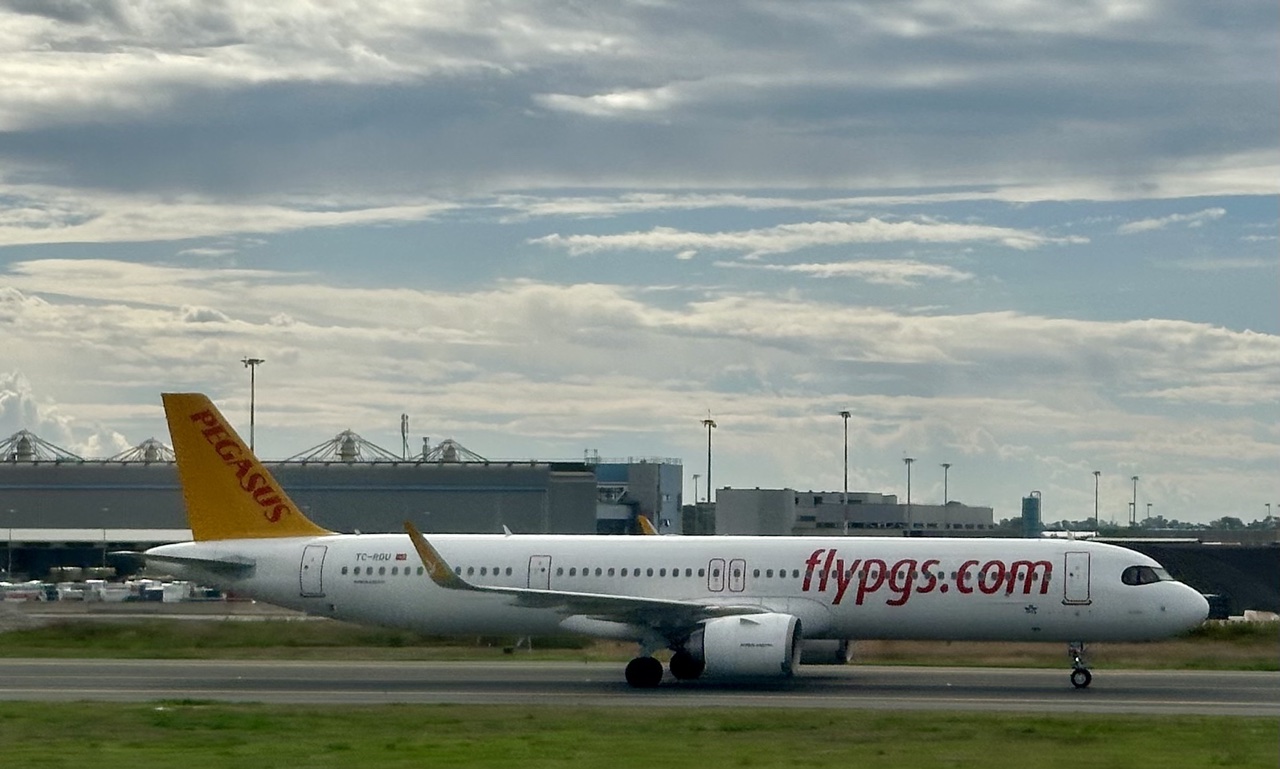
For aviation enthusiasts → The PC aircraft featured in the article is an A321neo (age: 2.6 years). It is currently parked at SAW.
Nevertheless, the mesmerizing Mediterranean (and its little sister, the alluring Aegean Sea) continues to call for the guests via airlines. If you’re interested, listen up and act now!
The Mediterranean and Aegean coasts will certainly not be empty this summer, and if foreign tourists are too hesitant, hotel owners will lower their prices as in the past, and domestic tourists will not want to miss this great opportunity.
“Frankfurt is the hardest hit at 26.8% down” And deservedly so, it’s a ghastly airport despite its one new terminal. Made worse by the crazy decisions of Fraport management – like, make customers walk for miles as we’ve removed the moving walkways to get more people into the shops. Looking for an elevator – sorry we’ve repurposed that space for more shops, walk up the stairs why don’t you.
Segrada Familia isn’t a church in Barcelona, that’s Sagrada Familia. I believe “Segrada” Familia is Trump’s policy for dealing with immigrant children.
I wonder if EES is making some people reluctant to deal with European travel. I hear little about it lately. Maybe things are going smoothly?
We fly in to Italy frequently from the UK and the border force have an official option to suspend the EES at their discretion. Article 9 of the regulations permits it in exceptional times. Also Lucca and Florence are full of Americans now.
Maybe some people aren’t doing the Med this year because they realized it’s hot as balls, the summer air quality is bad these days, and the revenge travelers have taken a region that is already slammed and slammed it harder. Demand down you say? Then maybe it’s just back to pre-revenge travel slammed. Either way, maybe people just realized they hate getting price gouged and stuck in traffic on the A8,