
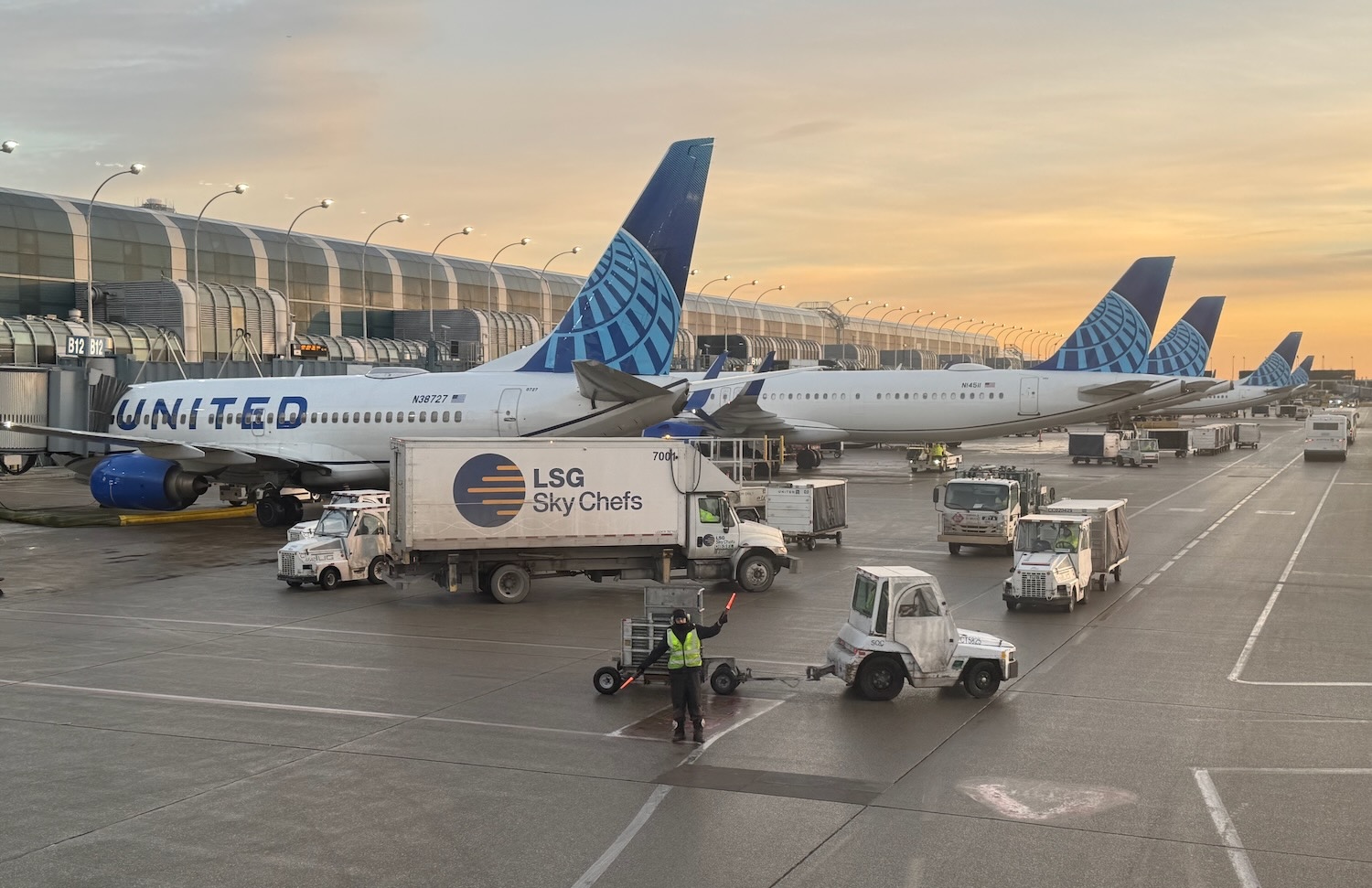
United Airlines is about to pour even more capacity into Chicago O’Hare, but leaked internal slides suggest the financial trend line there is already moving in the wrong direction.
United’s Chicago O’Hare Expansion Looks Like A Gate War, Not A Profit Strategy
Enilria flags a set of leaked internal slides, shared publicly by aviation insider JonNYC, that show a troubling datapoint for United’s Chicago performance: revenue per available seat mile at ORD is down 8.1% since 2022, versus 2.9% elsewhere, meaning the decline in Chicago is nearly three times worse than the systemwide trend.
That matters because United is not shrinking at O’Hare. It is escalating. The airline intends to operate up to 750 daily departures out of ORD this summer, its largest schedule ever at the airport.
> Read More: United Backs Up Its Chicago Threat With Record 750 Daily Flights At O’Hare
While this is great news for Chicago flyers, if the leaked numbers are accurate, the economics of that growth are already deteriorating, and the capacity wave has not even crested yet.
Michael Leskinen Basically Admitted This Isn’t About Profit
United Airlines CFO Michael Leskinen essentially confirmed these numbers in recent remarks about Chicago. His framing was not about building a better product or meeting demand. It was about gate protection and strategic flying, even if that means empty seats and lower margins in the near term:
“So they can fly around some empty airplanes, and there is some gate calculus around that. And so that puts us in a spot where for the long term, we have to protect our gate positions. It’s going to be a modest impact to our level of profitability…We are making money in Chicago. We made a nice profit last year in Chicago.”
This is not complicated. United is willing to accept weaker short-term performance to keep its gate portfolio intact and, ideally, to force American into a retreat that would reduce competition at O’Hare. The slides and the rhetoric point to the same goal: win the airport, then monetize it later.
The risk, of course, is that both carriers bleed out for longer than expected. Sometimes a “modest impact” has a way of becoming something else once a capacity war escalates and the fares drops to unsustainable levels (much to the benefit of ORD passengers).
United Wants To Do In Chicago What Delta Did In New York
The most interesting takeaway from the comment discussion is that this looks like an attempt to replicate Delta’s playbook in New York. The idea is simple: overwhelm a competitor with capacity, make the economics painful enough that they retreat, then consolidate pricing power once the dust settles.
There is some logic to that analogy. Delta spent years building an strong position at JFK and LaGuardia, and American eventually faded into the background. Delta then turned that strength into pricing power, corporate share, and a stronger loyalty ecosystem.
But there is also a key difference. New York has structural scarcity with limited slots. Chicago is important, but it is not New York, and O’Hare is not slot-controlled in the same way. Gates matter, yes, but competitive dynamics are different, and American has reasons to stay in Chicago even if the near-term financials are ugly. As View From The Wing pointed out, “Chicago will be long-term profitable for American if they are competitive there, because it’s arguably the second most important credit card market in the country. United keeps pushing the narrative that American is burning cash on flights but their actual profit comes from the co-brand credit card.”
In other words, I understand why United wants a JFK-style outcome at ORD, but I am not convinced it will be so clean, or so quick because AA’s profit center is credit cards, not flights.
CONCLUSION
United’s plan to fly up to 750 daily departures from O’Hare is being sold as growth, but the leaked slides suggest it is already coming at a cost, with Chicago revenue performance falling far faster than the rest of the system.
Michael Leskinen’s remarks make clear this is ultimately about defending gate position and trying to squeeze a competitor. If United gets its desired outcome, it will be very good for United and very bad for passengers long term. If it does not, this turns into a prolonged battle where the only guaranteed winners are travelers in the short run, while fares are suppressed and schedules balloon beyond what demand can reasonably support.
The question is not whether United can win. It is how much money it will burn to try, and whether American will blink first. But unlike in New York, it seems that this time AA has learned its lesson and will not retreat.





Stop pumping up that rancid cesspit of the universe located on and around Manhattan Island. We in Chicago are happy that we’re not them and will never be them, no matter how much they try to lord it over us that we’re not them. We have our own hometown airline that is trying to rid itself of a competitor, that’s all. Noo Yawk has two major airlines that are the most evil airlines in the world, the one from Atlanta and the “hometown airline” founded by Neelzebub. They do so little business in Chicago that they’re hardly even a blip. So to hell with them. Noo Yawk is not the center of the universe and only city that matters.
It sounds like you spend a lot of time thinking about New York for somebody who doesn’t want to hear about New York
O’Hare… here’s the thing… New York City doesn’t think about Chicago at all.
Looks like you missed this part of the UAL CFO’s Barclay’s presentation along with the rest of the information.
“RASM Growth: Achieved mid-single-digit RASM growth in early February at O’Hare.”
I knew we could count on you for a positive spin on this!
If United can pull off sustained RASM growth despite growing in ORD, then hats off to Kirby and Co…
That’s unlikely, but while citing one item in isolation makes good click bait it’s obviously misleading.
Does Kristina Munoz pay you to post so much on company time?
Matthew Klint, “I knew we could count on you for a positive spin on this!”
“I knew we could count on you” to take things out of context for click bait maximization. Seeing as though you tend/try to miss the big picture perhaps you should listen to airline analysts WRT the airline. Deutsche Bank analysts estimated that American is operating at a negative 9% margin at O’Hare, and that United’s margin is 5%.
https://www.businessinsider.com/united-airlines-cfo-belittles-american-airlines-in-fight-for-chicago-2026-2#:~:text=Deutsche%20Bank%20analysts%20estimated%20that,through%20Spirit%20Airlines'%20bankruptcy%20proceedings.
Not holding my breath though.
And on the other hand, remember that UA management still can’t agree to an flight attendant contract…
The ORD turf war continues and intensifies…
This will be the perfect storm to work against United if a FA contract gets ratified in the middle of all this. Because undoubtedly it will have large wage increases, and compound that with even more flights added to the UA ORD schedule. AA’s FA wage scale is already baked into its gambit here with increased schedules.
United strategy seems to be emotional, not like a fiduciary.
The flight attendant new contract numbers are already in projections.
We don’t have a definitive answer about that yet. Kirby has vaguely indicated that is the case, but UA revised upwards its 2025 earnings, specifically noting the labor savings.
Actually, we do. Michael Leskinen, the UAL CFO, stated it at the Barclay’s conference.
Brandon Oglenski, Airline and Transport Analyst, Barclays: Okay, but you do have outstanding labor deals that could add a couple-
Mike Leskinen, Chief Financial Officer, United Airlines: I have labor deals, I have the outsized industry inflation, but I have all the global procurement next goodness, I have better operations, I have upgauging. I have all of that in the mix, and when we give you EPS guidance, all, all of that is in the thinking. I fully expect to have labor deals done this year, and I fully expect to have to pay that bill, and that’s in my EPS guidance.
https://www.investing.com/news/transcripts/united-airlines-at-barclays-conference-strategic-optimism-amid-challenges-93CH-4511455
This is helpful. Thank you, rebel.
no company can provide guidance for unfinished labor deals.’
They can indicate what they are willing to pay but that is it.
At some point UA labor is going to get tired of subsidizing Scotty’s market share wars off of their salaries.
I have said for years that United is more committed to market share at the expense of profits and this is just further reflection that United is willing to repeat its disastrous 3q2025 revenue performance
Delta makes more money because it does not need to and does not do this.
Matthew’s assessment is correct. United is hoping to do to American not just in New York City but also LA but will fail to achieve it
That’s so aggressive of Delta counter to what LTD has been espousing. With regards to profits.
Net income often suffers during rapid growth because expenses—such as hiring, marketing, and operational scaling—often outpace revenue growth in the short term. This is common as companies prioritize market share over immediate profitability, leading to compressed margins. This is typically a temporary phase, with profits expected to rise once the expansion matures. Firms, like Amazon, have famously forgone profit for growth. This approach works best as a temporary, planned phase rather than a permanent state. Sustainable growth usually requires a balance where expansion does not entirely erode profitability. Given United’s relative growth rate their profitability is even more impressive.
It’s just a matter of time.
UA simply does not have to aggressively grow
It is a dream that you parroting UA execs have for UA to dominate and eliminate competition and be willing to lose money now to hope to gain that share later.
UA”s aggressive growth strategy is failed economically.
Economic principles show that degrading earnings to pursue strategies that have never resulted in long term profits for airlines; the sooner you grasp those principles, the sooner UA will perform as it is supposed to perform.
But it is no surprise that you say exactly what UA execs say.
There are very valid reasons that UA made just 2/3 of what DL made – and it has nothing to do with DL’s monopoly cities and the Amex relationship.
It has everything to do with DL’s ability to build something over years where Scott Kirby can’t stand to wait 3 days for paint to dry.
As if net income is the only metric of any importance.
2019/2025
Net Debt: UA +300m, DL +7.6b
Aircraft: UA +283, DL +91
4YR OCF/Capex/FCF (in $b)
UA: 30.9/23.4/7.5
DL: 29.2/23.7/8.8
TRASM/PRASM-CASM=
UA 2025: 17.88/16.18-16.46 = 1.42/-0.28, 2024:18.34/16.66-16.70 = 1.64/-0.04
DL 2025: 21.26/17.37-19.31 = 1.91/-1.94, 2024:21.37/17.65-19.30 = 2.07/-1.65
TATL destinations 2016/2025 : UA: 22/42 , DL: 32/34, AA: 21/20
TPAC destinations 2016/2025: UA: 23/32, DL: 15/8 , AA: 8/7
TLAT Destinations 2016/2025: AA: 92/97, UA: 57/66 , DL: 58/52
How about that DL net debt? Yikes! It’s just a matter of time.
you can spin all the numbers you want but the bottom line is that UA flies 10% more ASMs than DL and generated just 2/3 of DL’s 2025 profits.
You can and will do everything possible to argue against that statistic but that IS the bottom line.
and, if UA’s balance sheet was so great, they would be investment grade like DL and WN – but UA is not investment grade and they hold onto so much cash because they have such massive fleet commitments which would bankrupt them if there is a black swan.
Absent government aid, DL and WN would have likely been the only two US airlines to avoid bankruptcy when the airline industry collapsed during covid; both managed to pull down ten billion dollars in credit. UA took months to hawk its loyalty program for money, something every other airline also eventually did.
UA is simply less profitable and has a riskier balance sheet because they run a higher risk company built on the notion that they can force weaker players out of the market, something no other airline is trying to do – at least not near as publicly as UA
Everyone can see it – UA will harm itself trying to push AA out of ORD and likely not succeed at doing it anyway
If ifs and buts were candy and nuts every day would be Christmas. UAL’s debt rating has received a rapid series of upgrades and is one notch below investment grade. The only reason it is not investment grade like DAL’s, is UA’s 662 aircraft on order, arriving sooner and faster versus only 317 longer term orders for DL. Wall Street likes a conservative approach. Nothing wrong with sitting on your laurels and maximizing short term profits. DL is a fine airline.
UA: 1,077 aircraft, (230 WB), 185 WB/477 NB on order (15.5 average fleet age)
DL: 988 aircraft, (180 WB), 85 WB/232 NB on order (14.9 average fleet age)
UAL does not have an investment grade rating.
It holds far more cash than DL because of its massive capex commitments that could bankrupt the company in a black swan event.
UA generates 2/3 of the profits DL does despite flying 10% more capacity.
UA’s business strategies are not about profit maximization but attempting to grow share and eliminate competition, neither of which they are likely to attain on a long term basis.
DL has led the GLOBAL industry in revenues for years and profits among US airlines for well over a decade.
That is not resting on laurels but reaping the rewards of having built a top tier business and airline over the past 20 years.
and DL pays its people industry leading compensation while UA is at the bottom of the big 4.
No one expects you to admit reality but everyone else including Matthew can see it.
All you do by arguing is allow those of us that are committed to truth to speaking to those on various sites including here that don’t understand how it is UA that is chasing strategies that have never been prove to work long term in the US airline industry.
If onlys and justs were candies and nuts, then everyday would be Erntedankfest
TD, “It holds far more cash than DL because of its massive capex commitments that could bankrupt the company in a black swan event.”
It’s comical how little you know for an “airline analyst,” much less a casual observer of the industry. Remember Covid? Chess v checkers. Advantage United!
Delta plays 3D chess. UA plays checkers.
and UA’s supposed advantage sure doesn’t show up in the financials.
UA is the airline version of someone that needs Ozempic.
You think/pretend ‘financials’ are limited to one item from one of four GAAP financial statements. Checkers.
there are indeed a multitude of financial metrics that work which is why you can only find one that makes UA look good at the exclusion of a half dozen other ones
All UA does well is being large and bullying everyone else to try to fix UA’s own strategic failures.
UA is the airline equivalent of someone that needs Ozempic (or better yet Mounjaro which works better).
DL, meanwhile, has been going to the gym and competing in the Olympics for decades.
It’s an Ozempic vs. Olympic strategy. DL brings home the gold. UA fights for rust.
Who knew your analogies could be worse than your analysis? Poor LTD.
yes, we know that facts and data that paint anything but a positively good picture of UA is bad data to you but the facts and the analogy are spot on.
Delta is a multi-year Olympic gold champion while United is competing with excess weight and engaging in lifestyle habits that hurt its ability to compete.
Too funny. It’s obvious you didn’t look at the data I posted and you post no data except for net income. Analysis? Not.
I look at all the data and not just your cherrypicked excerpts.
Olympic gold winner Delta; Ozempic needing, rust pursuing United.
You obviously didn’t even look at all the data I posted or you wouldn’t have mischaracterized it. Analyst? Nope.
yes, we know about your cherrypicked data.
and yet UAL doesn’t generate profits in line with DAL even though UAL flies 10% more ASMs and has a billion dollar labor cost advantage.
UAL is Ozempic class; DL is Olympic class
the issue with doing this in Chicago is that there are two other airlines have hubs there. Not just AA, but also WN
UAL and AAL flights service increase at ORD would put pressure to Delta’s two mid-west hubs. Detroit and Minneapolis airports would lose some connecting traffic to Chicago.