
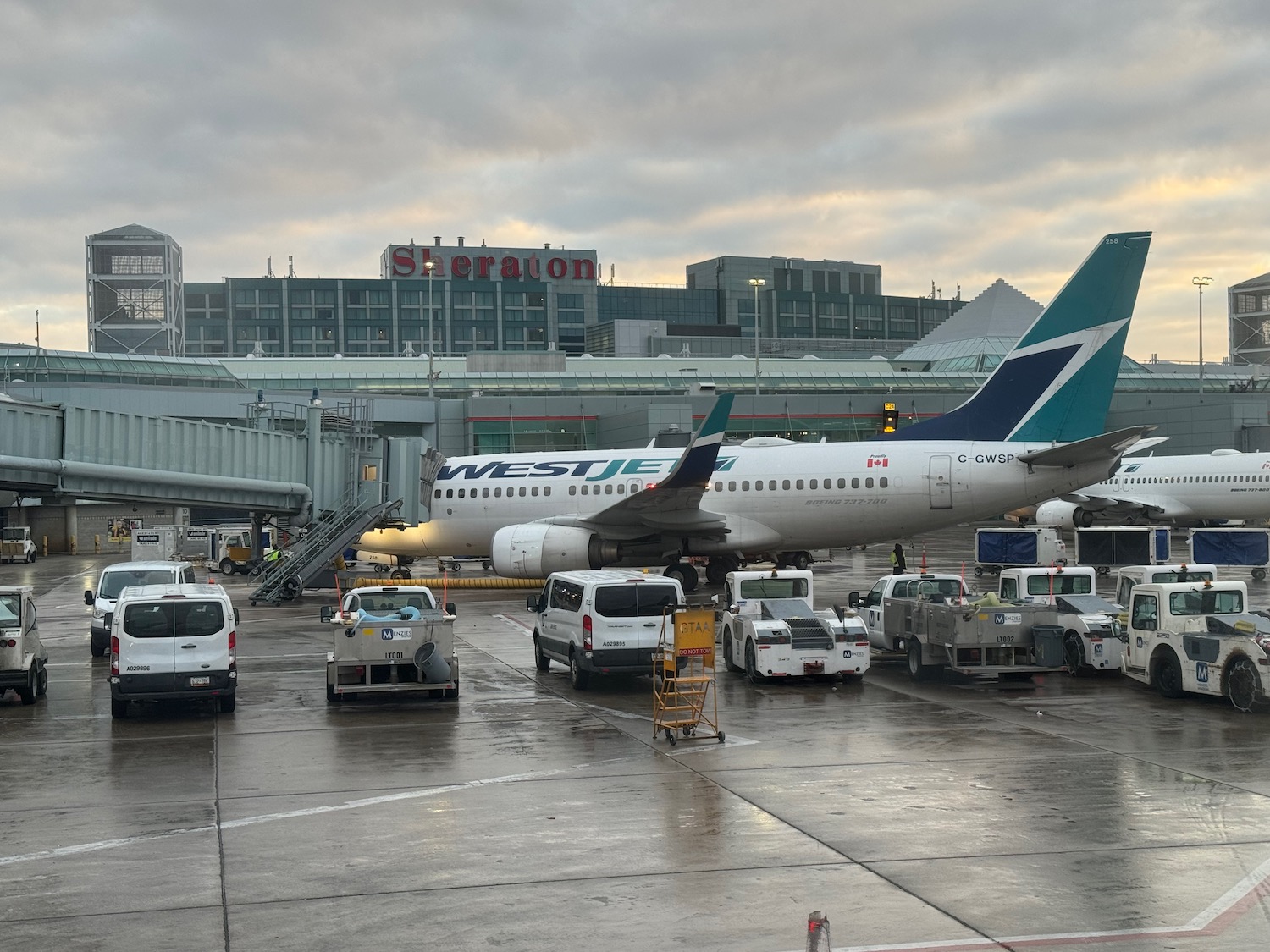
WestJet appears to have found a clever little trick to avoid paying passengers compensation after flight cancellations: swap a flight to a broken aircraft, cancel it, then blame “unplanned maintenance.”
WestJet Accused Of Using Sneaky Aircraft Swap To Avoid Paying Compensation
Canada’s Air Passenger Protection Regulations require airlines to pay cash compensation for many significant delays and cancellations that are within an airline’s control. But there is a big carveout: if the disruption is tied to “unplanned maintenance required for safety,” the airline can avoid paying compensation.
You can probably see where this is going.
A CBC Go Public investigation, highlighted by One Mile at a Time, found that WestJet may be using that maintenance carveout in a rather creative way.
The case involves a couple returning from Los Cabos, Mexico, to Canada on WestJet. Their flight was canceled, they arrived about 16 hours late, and when they filed for compensation, WestJet denied the claim by blaming “unplanned aircraft maintenance” that was “required for safety purposes.”
Fair enough, if true, even if this sort of carveout does not encourage Canadian airlines to be more preventive in their aircraft maintenance.
But flight data told a more interesting story. The aircraft originally assigned to the flight was reportedly swapped out at the same time the flight was canceled. The original aircraft then kept flying another route, while the replacement aircraft had already been sitting out of service for maintenance.
Did you catch that? In other words, the plane that was supposed to operate the flight was not the broken one. WestJet allegedly swapped in a broken aircraft, then used that broken aircraft as the reason to deny compensation. That’s quite manipulative, to put it mildly.
One Case Or A Pattern?
The CBC investigation did not stop with one flight. It reportedly found dozens of similar cases in which a tail number was changed to an aircraft that was already grounded or unavailable, followed very quickly by a cancellation and a denial of compensation based on maintenance.
The whole premise of the maintenance exception is that an airline should not be punished for a genuine safety issue that suddenly arises. Again, I get that: if a mechanical problem is discovered and the aircraft cannot safely operate, I do not want an airline pressured into flying it just to avoid paying compensation. That could compromise safety..
But that is very different from taking a flight that could have operated with one aircraft, swapping it to an aircraft that was already broken, canceling the flight, and then saying: sorry, unforeseen maintenance, no compensation for you.
That is gamesmanship and if true, I hope WestJet is held (severely) accountable.
WestJet’s Explanation Is Not Very Convincing
WestJet reportedly did not directly answer CBC’s questions about the specific pattern, instead offering a general explanation:
“Planes are sometimes reassigned to minimize the impact of disruptions.”
Of course they are.
Airlines swap aircraft all the time. That is not inherently suspicious. If one aircraft goes mechanical, another aircraft may be pulled in. If a delay in one city would cascade through the network, dispatchers may reshuffle aircraft to reduce the overall damage…that’s true at every airline.
But that does not answer the relevant question here. Why were flights apparently being reassigned to aircraft that were already out of service, and then canceled almost immediately? And why were passengers then denied compensation on the basis of maintenance involving the replacement aircraft?
The Airline Compensation Problem And Solution
I am not naive about airline compensation claims. Airlines have every incentive to characterize delays and cancellations in the way most favorable to them. If a cancellation is “within carrier control,” they may owe money. If it is “safety-related maintenance,” they may not.
That creates a very obvious incentive problem.
The passenger usually has very little information. The airline has all the operational records. The passenger gets a boilerplate denial and is left to either accept it or spend months or years fighting through a complaint process.
That is not a real consumer protection system.
Canada’s rules are better than nothing, but a rule that can be evaded through creative aircraft assignment is not strong enough. If regulators allow airlines to simply swap a flight to a broken aircraft and then deny compensation, the maintenance exception becomes a loophole big enough to, well, taxi a 737 through.
The solution should be straightforward. If an airline denies compensation based on maintenance, it should have to identify the aircraft originally assigned to the flight, the aircraft actually assigned at the time of cancellation, the timing of any swap, and the specific mechanical issue that prevented operation.
If the original aircraft was available and flew another route, while the replacement aircraft was already grounded, the airline should face a heavy presumption that compensation is owed. And if an airline repeatedly misclassifies disruptions to avoid paying compensation, fines should be painful enough to change behavior, not to mention a class action lawsuit that may already be forming as I write this…
CONCLUSION
WestJet has been accused of using aircraft swaps to avoid paying compensation after cancellations. The allegation is simple: assign a flight to a broken aircraft at the last minute, cancel the flight, then deny passengers compensation by blaming unplanned maintenance.
Maybe WestJet has a better explanation, but “aircraft are sometimes reassigned” is not good enough. Everyone knows aircraft are reassigned. The question is whether WestJet used reassignment as a tool to transform compensable cancellations into non-compensable safety-related maintenance events.
If that is what happened, regulators should come down hard. Airline compensation rules are already hard enough for passengers to enforce, but they become meaningless if carriers can play shell games with tail numbers and call it “safety.”





The first problem is people expecting anything for airline issues not involving loss of life. Stuff happens in life and you lose for lack of a better word. Catch the next flight, you’ll live.
We have become a society of victims expecting something for nothing.
I do not agree. Airlines, absent consumer protections, are very difficult to hold accountable and leaving it to “market forces” or “capitalism” is silly in such a high-regulated industry.
Thank you, Matt. If Kyle ever actually flew, he’d know better. I bet in reality, he’s pretty upset when airlines fail to operate timely or reliably, and he’d gladly accept $250-800 worth of compensation, depending on the circumstances. I’ll never understand those that shill for the industry on here and elsewhere, against workers and consumers. Like, are they getting paid by Airlines for America to resist similar regulation in the US, or are they just useful idiots?
I fly monthly at a minimum, why so judgmental? I flew Sunday night on an overnight flight with less than 40 people on it, no way United made money on that flight, but they didn’t cancel it to save money. And I certainly don’t vouch for the airlines but as I said, stuff happens occasionally. No one is forced to fly and issues are rare. IF we had proof they cause delays and cancellations to increase profits, maybe the government needs to be involved but I just don’t see it.
I’ll stick with too many people want to play victim and get something for nothing. Let the consumer decide with their wallet if they aren’t happy with how an airline operates. Or they can always drive or take a bus or train.
As for the insult, watch one of my old films to see what I think of you. Chaos Men is a good one.
Horrible take. No one is ‘playing victim.’ Airlines and people that violate the law should pay. Really quite simple.
Also, wishing violence upon others is not a winning message for any debate.
Violence? Where did I wish violence on you or anyone? My films were adult in nature, certainly not violent.
And you are the one that attacked me by claiming I don’t fly.
You do see the inherent contradiction in promoting such anti-consumer, anti-worker, pro-industry conservative economics on here all the time, while producing such socially liberal content? By all means, you do you.
A 16 hour delay, while not a loss of life, is still a rather major and disruptive inconvenience.
Huge fan of EU/UK 261 and Canada’s APPR. Sure, these programs could be further streamlined and improved. However, the fact is that the US has nothing. We deserve better in the US.
The reality that ‘Canada specifically excludes disruptions due to unforeseen maintenance as being eligible for compensation’ is a major loophole which WestJet is trying to exploit. That said, the burden should be on the airline, not the passengers, to prove that the defense to claims is valid.
In the past, I’ve received compensation from Air Canada in accordance of APPR as well; no issues; no hassle; relatively efficient, too. Hopefully these issues with WestJet are indeed limited. Tanks to Matt and others for reporting on it! The attention to expose sneaky practices should prevent more abuse.
Good article Matthew. I completely agree. Westjet appears caught red-handed. I hope they are shamed and the penalties are severe for these shaningans. Although my guess is some lawyer has already said their liability is limited, even if a pattern is proved. Please mark this story for follow-up!
If what they’re doing is just trying to avoid compensation, that’s not good, but I think the thing to investigate is what the broken aircraft was supposed to be doing before the switch, and what the working aircraft was switched to do. With the information we have, this could be as innocuous as reacting to a real unforeseen maintenance issue by swapping aircraft so that the original affected flight can operate and a less important flight can be cancelled. If that’s the case, it’s totally reasonable, even if it doesn’t look good.
As I understand it, the issue is that the swapped aircraft had been out of service for weeks.
Easy, mandate airlines to deposit passenger compensation in escrow whenever a delay or cancellation happens. Airlines, then, would have to prove to their regulators that delay or cancellation happened due to a circumstance outside their control. Otherwise, the escrow account will automatically compensate passengers.
“If that is what happened,” then it is definitely not good for WS!
For aviation enthusiasts → The WS jetliner in the article’s photo is a B737-700 and it is 16.5 years old.
So they had 1 working plane for 2 routes… 1 of the flights was going to get cancelled. They picked one and now everyone wants a handout. Reality is that if the Cabo flight went the other route would have been cancelled and those passengers would be mad too. If they would have cancelled both and swapped the broken aircraft onto both, then you’d have a smoking gun… But you don’t.
You don’t find it suspect that they assigned a plane to a route when 1.) they knew it was broken and 2.) it had been broken for weeks?